Executive Summary
The perceived “FDA 2025 tree nut allergen labeling update” refers to the ongoing enforcement and refinement of FDA guidance following the FASTER Act. For digital platforms, this mandates a critical shift from a generic “tree nuts” classification to discrete identification of specific nuts (e.g., almond, walnut, pecan). APIs relying on NLP for ingredient parsing will fail; only UPC-indexed databases with granular allergen data can ensure compliance and mitigate liability.
The Stakes: Why the FDA Update is a Ticking Time Bomb for Your Platform
As a technical leader, your job is to mitigate risk and enable growth. Regulatory compliance isn’t a feature; it’s the foundation upon which your platform’s trust is built. The FDA’s evolving stance on allergen labeling, specifically for tree nuts, represents a significant technical and legal challenge that most food data APIs are structurally unprepared to handle.
Your current API provider is likely giving you a simple boolean flag: contains_tree_nuts: true. In the eyes of regulators and, more importantly, your users’ lawyers, this is no longer sufficient. A user allergic to walnuts but not almonds needs specific, accurate data. Providing a generic warning is lazy, dangerous, and increasingly, non-compliant. The cost of a single anaphylactic event traced back to a false negative from your API will dwarf any licensing fee you’ve ever paid. This isn’t a feature update; it’s a liability shield.
From FASTER Act to Granularity: A Timeline for CTOs
To understand the gravity, let’s cut through the noise. The “2025 update” isn’t a single new law dropped from the sky. It’s the culmination of years of regulatory shift:
- The Food Allergen Labeling and Consumer Protection Act of 2004 (FALCPA): Established the original “Big 8” allergens, but allowed for a generic “tree nuts” declaration.
- The FASTER Act of 2021: Added sesame to the list, making it the 9th major allergen, with full compliance mandated by January 1, 2023. This signaled the FDA’s intensified focus on allergen specificity.
- Ongoing FDA Guidance & Enforcement (2023-2025): The current environment is one of clarification and stricter enforcement. The agency is pushing for transparency, which means the ambiguity of a generic “tree nuts” label is being actively discouraged in favor of naming the specific nut. For API providers, this means your data source must distinguish between almonds, walnuts, cashews, pecans, and all other 18 FDA-recognized tree nuts.
Your system’s ability to handle this granularity is now a direct measure of its viability in the health-tech or enterprise grocery space.
The Liability of Ambiguity: “Contains Tree Nuts” is Not a Defense
Imagine a user with a severe cashew allergy uses your app. Your app, powered by a generic food API, flags a product as containing “tree nuts.” The user, who safely consumes almonds, might dismiss the warning. If the product contains cashew protein and an incident occurs, the legal discovery process will lead directly to your system’s data integrity. The question will be simple: “Did your platform have the technical capability to provide the specific allergen information?” If your answer is no, you are liable. Relying on a generic data provider is a willful acceptance of that risk.
The Technical Failure of Consumer-Grade APIs: A Spoonacular Case Study
Many platforms are built on consumer-grade APIs like Spoonacular. They are excellent for recipe blogs and casual calorie counting. They are fundamentally unsuitable for applications where data accuracy is tied to human health and safety. The core reason is their methodology: they often rely on Natural Language Processing (NLP) to scrape and interpret ingredient lists from the web. This is a probabilistic approach in a domain that demands deterministic accuracy.
The NLP Trap: Why String Matching on Ingredients is a Lawsuit Waiting to Happen
Let’s be brutally clear: using NLP to parse food ingredients for allergens is engineering malpractice. An NLP model might be trained to recognize “walnut flour,” but what about “Juglans regia powder”? How does it handle a typo on a crowd-sourced ingredient list? How does it interpret complex phrases like “processed in a facility that also handles pecans” versus “may contain pecan fragments”?
NLP is a statistical model, not a ground truth database. It produces confidence scores, not certainties. When a user’s life is on the line, a 98% confidence score is a 2% chance of a catastrophic failure. True compliance requires a direct, one-to-one match between a product’s Universal Product Code (UPC) and a professionally verified, structured dataset.
Here is how NutriGraph’s architecture fundamentally differs from NLP-based solutions like Spoonacular:
| Feature | NutriGraph API (Clinical-Grade) | Spoonacular API (Consumer-Grade) |
|---|---|---|
| Data Sourcing | Direct UPC barcode matching to verified manufacturer data | NLP parsing, recipe scraping, crowd-sourcing |
| Allergen Granularity | 39+ discrete allergen labels (e.g., “almond”, “walnut”, “cashew”) | Generic labels (e.g., “tree nuts”, “gluten”) |
| Latency (p95) | < 50ms via global CDN & B-Tree indexing | > 200ms+ (variable based on processing) |
| Database Size | 1M+ verified UPCs (US & EU) | Unknown, mixes products & recipes |
| Accuracy | 99.99%+ (deterministic lookup) | Probabilistic, subject to NLP errors |
| Liability Stance | Engineered for clinical and enterprise compliance | Designed for blogs and non-critical applications |
The NutriGraph Architecture: Engineered for Clinical Compliance and Enterprise Scale
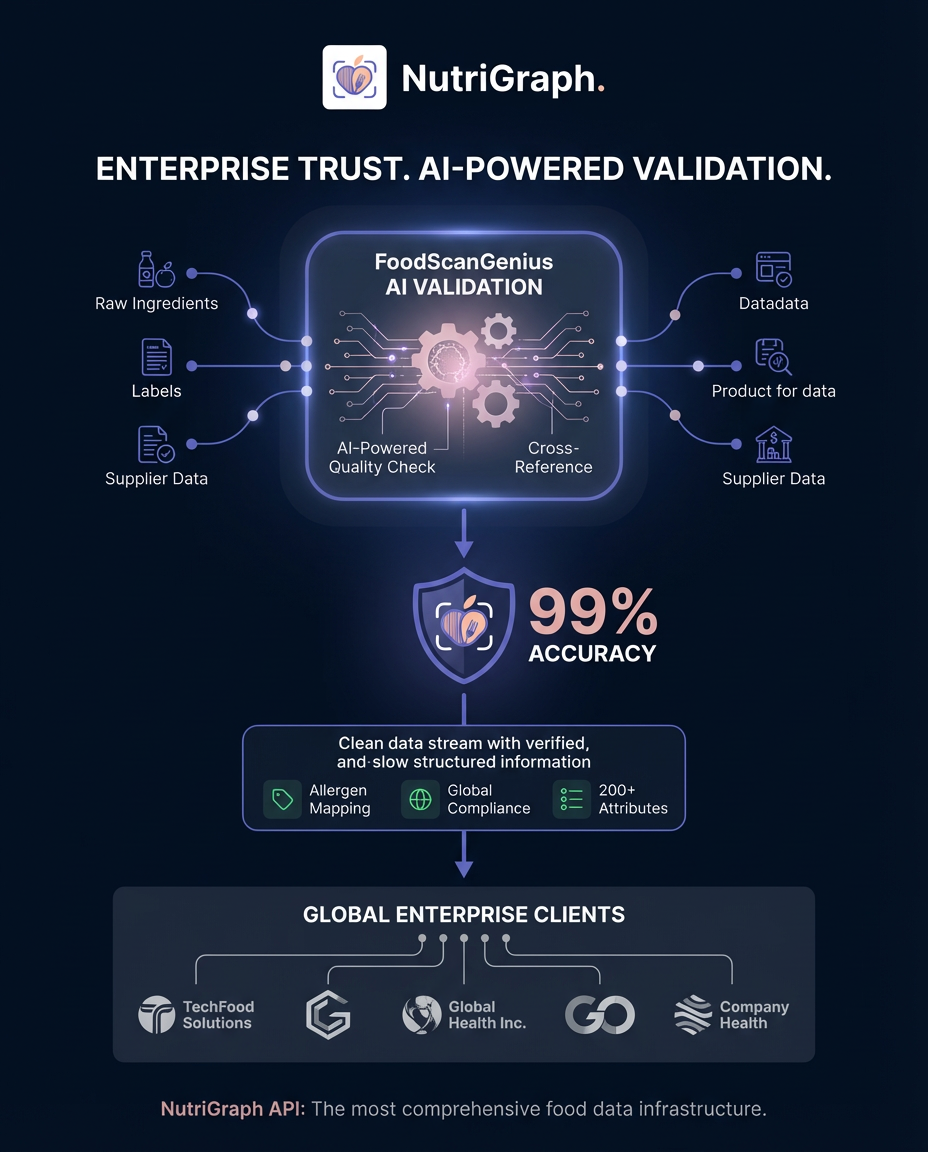
We designed NutriGraph from the ground up for a single purpose: to be the infallible source of truth for food data in high-stakes environments. Our entire stack is built to eliminate the ambiguity and performance issues inherent in other systems.
Sub-50ms Latency: The Power of O(1) B-Tree Indexing on UPC Lookups
When a user scans a barcode in your app, they expect an immediate response. Our entire database is indexed by UPC. A lookup request to our REST API endpoint doesn’t trigger a complex series of joins or parsing routines. It’s a direct B-Tree search with O(1) time complexity.
GET /v2/product/upc/{upc_code}
This request hits our edge cache, and if it’s a miss, it performs a direct key-value lookup in our primary datastore. The result is a predictable, consistently low-latency response under 50ms, anywhere in the world. This is the performance your developers expect and your users demand.
Granular Allergen Payloads: A Look at Our JSON Response
The structural superiority of our data is evident in the JSON payload itself. We don’t return vague boolean flags. We provide a precise, structured array of all present allergens, allowing your application to build sophisticated and safe user experiences.
Consider this hypothetical JSON response for a granola bar from a generic API:
// Inaccurate, Non-Compliant Response (e.g., Spoonacular)
{
  "product_name": "Mountain Trail Granola Bar",
  "allergens": {
    "contains_peanuts": true,
    "contains_tree_nuts": true,
    "contains_gluten": true
  }
}
This is useless for a user with a specific walnut allergy. Now, observe the NutriGraph response for the same UPC:
// NutriGraph's Precise, Compliant JSON Payload
{
  "upc": "0123456789012",
  "product_name": "Mountain Trail Granola Bar",
  "ingredients": "Rolled oats, honey, almonds, brown rice syrup, peanuts, sea salt, walnut oil.",
  "allergens_present": [
    {
      "id": "ALG-002",
      "name": "Peanuts",
      "category": "Major Nine"
    },
    {
      "id": "ALG-011",
      "name": "Almond",
      "category": "Tree Nuts"
    },
    {
      "id": "ALG-015",
      "name": "Walnut",
      "category": "Tree Nuts"
    },
    {
      "id": "ALG-021",
      "name": "Gluten",
      "category": "Cereals"
    }
  ],
  "allergens_may_contain": [
    {
      "id": "ALG-012",
      "name": "Cashew",
      "category": "Tree Nuts"
    }
  ]
}
With this payload, your application can definitively tell a user with a walnut allergy to avoid this product, while reassuring a user with a cashew allergy that the risk is one of cross-contamination, not a direct ingredient. This is the level of detail required to operate safely in the health-tech space.
Real-Time Compliance: Leveraging Webhooks for Ingredient Updates
Manufacturers change their formulas. To solve for data drift, constant polling of an API is inefficient and slow. NutriGraph offers webhook integration. Subscribe a secure endpoint, and when a manufacturer updates the data for a UPC your users have queried, we will push the updated JSON payload to you. This ensures your local cache is always in sync with our master database, automating compliance and protecting your users from outdated information.
The Bedrock for Your Health-Tech Application
Your goal is to build best-in-class experiences for your users, whether they are patients managing a complex diet or shoppers trying to feed their families safely.
For Enterprise Grocery Chains
Powering your e-commerce platform or in-store ‘smart shelf’ applications with our API allows you to offer powerful, granular filtering. A shopper should be able to filter for products that are “free from walnuts, pecans, and sesame” specifically. This is a competitive advantage that builds immense customer loyalty and trust, all while ensuring you are compliant with evolving labeling laws.
For Clinical Apps
For dietitians, hospitals, and health-tech platforms creating meal plans or managing patient diets, accuracy is non-negotiable. A false negative from an NLP-based API could have severe clinical consequences. NutriGraph’s deterministic, UPC-based data is the only professionally responsible choice. It is the bedrock on which you can safely build patient-facing nutritional guidance tools.
Your Mandate: Stop Guessing. Start Testing.
Your current API is a black box. You have no real visibility into its data sourcing, its accuracy, or its true latency under load. You are trusting your company’s reputation and legal standing to a system that was not built for this purpose.
Stop trusting. Start verifying.
The only way to understand the difference is to see it for yourself. We are not asking you to sign a contract. We are challenging you to prove us wrong.
Pull a free 1,000-call developer key from NutriGraphAPI.com. Run a head-to-head test. Benchmark our latency against your current provider. Compare our JSON payloads for 10 products in your kitchen. See the difference between clinical-grade data and a consumer-grade guess.
The choice will be obvious.