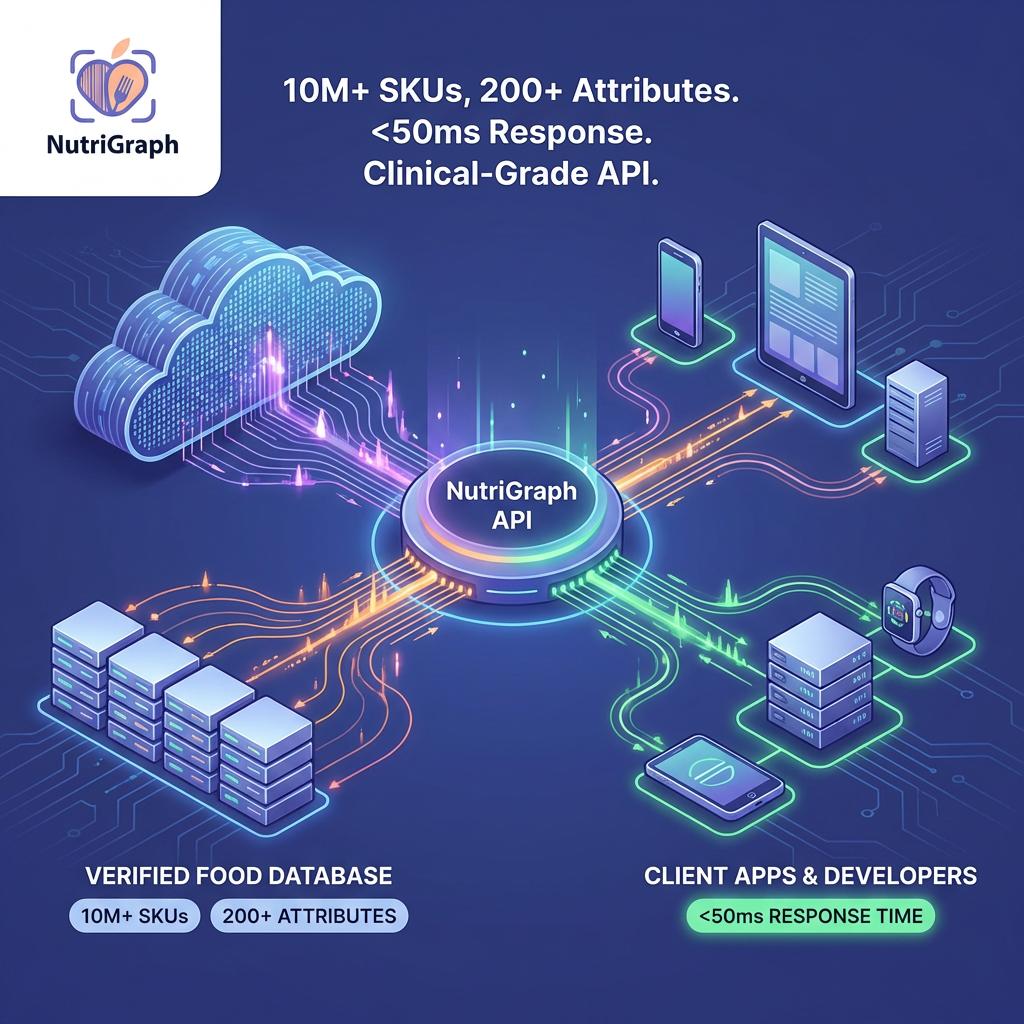
Executive Summary
Spoonacular API pricing operates on a tiered, points-based system where costs are tied to daily API points, requests, and data results. Plans range from a free tier limited to 50 points/day to enterprise solutions starting at $499/month for 25,000 points/day, complicating predictable cost modeling for high-volume, production applications.
Your Search for ‘Spoonacular API Pricing’ Ends Here. Your Due Diligence Begins.
You’re a CTO, a Lead Developer, or a Founder in the health-tech space. You’re not just looking for a price tag. You’re calculating the total cost of ownership. You’re evaluating risk, performance, and the architectural soundness of a critical component in your stack. You searched for Spoonacular’s pricing, but what you’re really asking is, “Is this the right foundation for my application?”
For a simple recipe blog, perhaps. For a clinical healthcare application, an enterprise grocery platform, or any system where data accuracy is non-negotiable, a points-based pricing model built on a consumer-grade database is a foundational liability. The true cost isn’t on their pricing page; it’s measured in milliseconds of latency, the ambiguity of NLP-based data, and the risk of a single, catastrophic data error.
This analysis isn’t just about comparing prices. It’s about comparing philosophies. Let’s deconstruct the real costs.
The Flaw in the Model: Why Points-Based Pricing Fails at Scale
Spoonacular’s model, like many others, uses a system of “points.” A simple query might cost 1 point. A complex query with nutritional data might cost 5 points. This seems straightforward until you project it onto a production environment with millions of calls.
This model introduces three critical problems for engineering leaders:
- Cost Unpredictability: Your monthly bill becomes a function of user behavior, not just user volume. If users start using a more data-intensive feature, your costs can spiral without a corresponding increase in revenue. Budgeting becomes guesswork.
- Architectural Constraints: Developers are incentivized to architect solutions that use the fewest points, not the solutions that provide the best user experience. It’s a classic case of the business model dictating—and degrading—the technology.
- Penalizing Complexity: The model inherently penalizes the most valuable queries. The deeper and more specific the data you need (e.g., micronutrient data for a specific UPC), the more you pay. This is antithetical to building a sophisticated, data-rich application.
At NutriGraph, we believe in predictable, transparent pricing that scales with your success. But pricing is secondary to the core architectural differences. Let’s put the numbers on the table.
NutriGraph API vs. Spoonacular: A Technical Comparison
When you’re building an enterprise application, you don’t compare marketing bullet points. You compare system architecture and performance metrics.
| Feature | NutriGraph API (Enterprise Grade) | Spoonacular API (Consumer Grade) |
|---|---|---|
| Avg. Latency (p95) | < 50ms (Global CDN) | Variable (Often > 300ms) |
| Data Source | Direct UPC Barcode Match | NLP & Heuristic Matching |
| Database Size | 5M+ Verifiable CPG Items | Undisclosed / Varies |
| Allergen Granularity | 200+ Clinical-Grade Labels | Generic (e.g., “Contains Nuts”) |
| Indexing Method | O(1) B-Tree on UPC/GTIN | Full-Text Search on Unstructured Data |
| Pricing Model | Predictable Per-Call / Volume Tiers | Complex Points-Based System |
The Critical Flaw of NLP in Clinical Applications
Here lies the most significant differentiator: how the data is sourced, parsed, and served. Spoonacular relies heavily on Natural Language Processing (NLP) to scrape and interpret recipe ingredients from across the web. For a recipe app, this is a clever solution. For a health application managing a user’s severe peanut allergy, it is unforgivably dangerous.
NLP is, by its nature, probabilistic. It makes educated guesses. It might interpret “flour” as wheat flour, but it could be almond flour. It might not distinguish between “peanut oil” and a refined oil that is safe for some allergic individuals. This ambiguity is unacceptable when user health is on the line.
This is not a theoretical risk. An NLP model that misinterprets an ingredient list and fails to flag a critical allergen is a multi-million dollar lawsuit waiting to happen. It’s a brand-destroying event.
The NutriGraph Approach: Deterministic, Unambiguous Data
NutriGraph is built on a different foundation: ground truth. Our system is built around UPC and GTIN barcodes—the universal standard for consumer-packaged goods.
- Direct Manufacturer Data: We ingest data directly from manufacturers and trusted aggregators.
- UPC-First Indexing: Every query is indexed via its unique product identifier. Our B-Tree indexing on 12-digit UPCs provides constant time, O(1), lookups. There is no ambiguity.
- Granular, Clinical-Grade Allergen Labeling: We don’t just say “Contains Dairy.” We provide specific, machine-readable labels like
CONTAINS_CASEIN,CONTAINS_WHEY,CONTAINS_LACTOSE. This level of granularity is essential for building applications for users with specific sensitivities or conditions like Celiac disease or Alpha-gal syndrome.
Consider the difference in the JSON payload for a simple query.
A generic API might return:
{
  "product_name": "Protein Bar",
  "allergens": ["nuts", "dairy"]
}
This is a black box. Which nuts? What kind of dairy?
The NutriGraph API returns an unambiguous, actionable payload:
{
  "upc": "012345678901",
  "product_name": "PerformancePro Protein Bar, Choc Peanut",
  "allergen_flags": [
    {"allergen_id": "F0012", "name": "Peanuts", "level": "CONTAINS"},
    {"allergen_id": "F0025", "name": "Milk - Casein", "level": "CONTAINS"},
    {"allergen_id": "F0031", "name": "Soy Lecithin", "level": "CONTAINS"},
    {"allergen_id": "F0014", "name": "Almonds", "level": "MAY_CONTAIN_TRACES"}
  ],
  "certifications": ["CERT_GLUTEN_FREE"]
}
Which JSON object would you rather build your application’s logic on? Which one would your legal and compliance teams approve?
Latency is Not a Feature, It’s a Prerequisite
In the world of mobile apps and interactive web experiences, latency is a user-retention killer. A 300ms delay in a search-as-you-type function feels broken. A barcode scanner that takes half a second to return a result is frustrating.
Spoonacular’s reliance on complex queries and NLP parsing introduces unavoidable latency. NutriGraph’s architecture is purpose-built for speed. Our globally distributed infrastructure, combined with our highly efficient UPC-based indexing, ensures that 95% of all API calls return in under 50 milliseconds. This isn’t a goal; it’s a guaranteed part of our SLA for enterprise clients.
This performance allows for entirely new user experiences:
- Real-time basket analysis: Scan an entire grocery receipt and get instant dietary compliance feedback.
- On-the-fly meal planning: Drag and drop items into a meal plan and see a complete nutritional and allergen profile update in real-time.
- Augmented reality overlays: Point a phone camera at a grocery shelf and instantly highlight compliant products.
These experiences are impossible with a high-latency API. Your application’s potential is directly capped by the performance of its data provider.
The Developer Experience: Stop Fighting Your API
Your engineers’ time is your most valuable resource. A poorly designed API with unpredictable costs and performance is a constant drain on that resource.
NutriGraph was built by engineers who have deployed and scaled mission-critical applications. Our developer experience is a core part of the product:
- RESTful Principles: Clean, predictable, and resource-oriented endpoints.
- Clear Documentation: Interactive documentation with code samples in multiple languages.
- Webhook Integration: Proactive notifications for data updates, recalls, or formula changes for products your users care about.
- Predictable Rate Limits: No complex point system. You get a clear, high-throughput rate limit that you can build your architecture around.
Stop wasting sprint cycles trying to optimize API point consumption or caching stale data to compensate for a slow provider. Start building features that deliver value to your users.
Stop Guessing. Start Building.
You came here looking for a price. You should leave with a clear understanding of value. The cost of an API isn’t its monthly subscription fee. It’s the latency that churns users, the ambiguous data that creates liability, and the developer friction that slows your roadmap.
We are not the cheapest option. We are the most valuable. We are the bedrock for serious applications.
But don’t take our word for it. The numbers don’t lie. Your current provider’s latency is a liability. We’re confident ours is better. Go to NutriGraphAPI.com, pull a free 1,000-call developer key, and run a head-to-head test. See for yourself what a sub-50ms response time on clinical-grade data feels like.