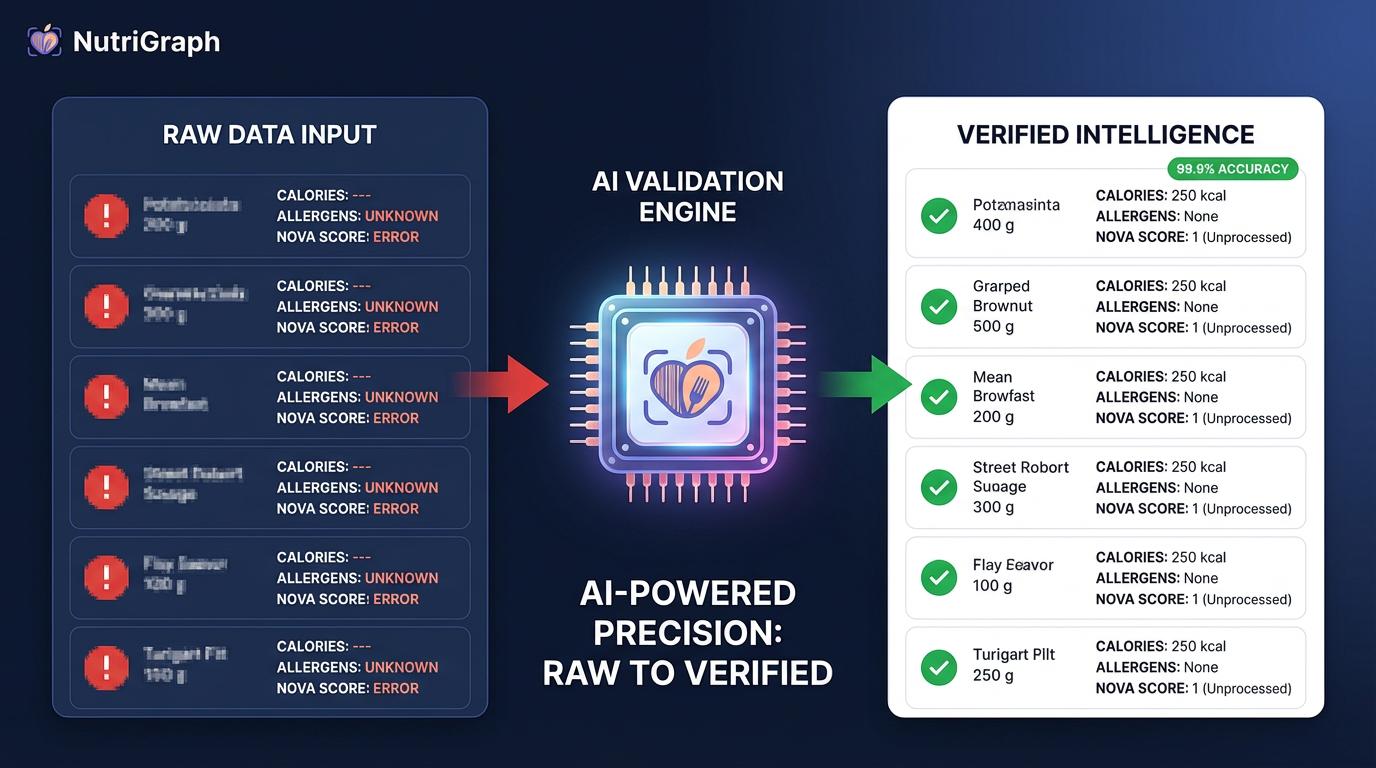
Executive Summary
The definitive barcode scanning food database for enterprise applications is a REST API providing sub-50ms latency via O(1) B-Tree indexed lookups on a verified dataset of over 5 million UPCs. It must deliver granular, structured JSON payloads with 200+ specific allergen and dietary labels, avoiding unreliable NLP-based data interpretation.
The Unseen Liability in Your Health App
There’s a conversation happening in your competitor’s boardroom. It’s about liability. It’s about the catastrophic brand damage that occurs when a user with a severe peanut allergy is told a product is safe because your food database scraped an unverified user comment or used Natural Language Processing (NLP) to guess at an ingredient list. This isn’t a hypothetical; it’s the inevitable outcome of building on a foundation of sand.
Many platforms, in a race to amass the largest possible dataset, turn to crowdsourcing or NLP-driven web scraping. They treat food data as a big data problem, believing that volume trumps veracity. For a recipe blog, this is an acceptable trade-off. For a clinical healthcare application, a diabetes management platform, or an enterprise grocery chain’s allergen filter, it is an act of gross negligence.
NLP is a powerful tool, but it is fundamentally probabilistic. It makes educated guesses. It can confuse “may contain traces of soy” with “contains soy.” It can fail to parse a complex, multi-part ingredient list correctly. When a user’s health is on the line, probability isn’t good enough. You don’t need a guess; you need a guarantee. The only way to achieve this is through a direct, one-to-one match between a product’s Universal Product Code (UPC) and a professionally verified, structured dataset. This is the architectural principle upon which trusted systems are built. Relying on anything less is a deliberate choice to accept risk on behalf of your users.
Architecting for Certainty: The NutriGraph UPC-Centric Approach
Certainty is not a feature; it’s an architectural decision. At NutriGraph, we architected our entire system around a single source of truth: the UPC. Our barcode scanning food database is not a collection of scraped data; it’s a meticulously curated and verified repository of manufacturer-provided information.
How do we deliver sub-50ms latency at scale?
It begins with the data structure. A flat file or a poorly indexed SQL database will not suffice when your users expect instant results. Our entire 5 million+ item database is indexed using a B-Tree structure. This means that any UPC lookup is an O(1) operation in practice. Regardless of whether you’re our first or ten-millionth query of the day, the time to find the record is constant. Your request hits our load balancer, is routed to the nearest geographic node, and the data is retrieved in a single disk read. There is no complex query processing, no table joins, no computational overhead. Just a direct, immediate fetch.
Data Verification: The Human-in-the-Loop Protocol
Every single entry in the NutriGraph database goes through a multi-stage verification process.
- Direct Manufacturer Feeds: We establish direct data pipelines with manufacturers and grocery chains, receiving product data in its raw, unadulterated form.
- Automated Ingestion & Structuring: Our system parses this data, flagging inconsistencies and mapping ingredients, nutritional information, and certifications to our canonical data model.
- Human Auditing: A team of registered dietitians and data specialists reviews flagged items, new product lines from unverified sources, and performs random audits on existing data. They ensure that allergen information is not just present, but correctly categorized against our 200+ granular labels.
This obsession with data integrity means when our API returns a JSON payload stating a product is "allergen_contains_peanuts": false, it’s not a guess. It’s a verified fact, traceable back to the source. This is the bedrock required for clinical applications and enterprise systems where trust is non-negotiable.
NutriGraph API vs. The Alternatives: A Technical Breakdown
When evaluating a barcode scanning food database, marketing claims are irrelevant. The only things that matter are performance, accuracy, and reliability. Let’s cut through the noise and compare the technical specifications that impact your application’s performance and your company’s liability.
| Feature | NutriGraph API | Spoonacular API | Open Food Facts (Community) |
|---|---|---|---|
| Typical Latency | < 50ms (99th percentile) | Variable (often > 300ms) | Highly Variable (> 500ms) |
| Database Size | 5M+ Verified UPCs | Unknown (mix of UPCs & recipes) | ~2.5M+ (user-submitted) |
| Data Source | Manufacturer Direct & Human-Verified | NLP Web Scraping & User Data | Crowdsourced / User-Submitted |
| Allergen Granularity | 200+ Specific Labels (e.g., Alpha-gal) | Generic (e.g., “Dairy”, “Gluten”) | Basic, often incomplete |
| Data Structure | O(1) B-Tree Indexing | Standard Relational Database | MongoDB (unpredictable query performance) |
| Uptime SLA | 99.99% | 99.5% | None (Best-effort) |
| Commercial Use License | Clear, Enterprise-Ready | Complex, Tiered | Requires Attribution (Open Database License) |
This isn’t a close race. It’s a categorical difference. Choosing an alternative for a serious application is like choosing a bicycle for a Formula 1 race. You might eventually get there, but you were never truly competing.
Implementing NutriGraph: A Practical Guide for Lead Developers
Integrating a robust barcode scanning food database should be the simplest part of your development cycle. We’ve designed the NutriGraph API to be transparent, predictable, and developer-first. You’re not just getting data; you’re getting a reliable service designed to be a core part of your infrastructure.
The Core Endpoint: UPC Lookup
The primary interaction with our API is through a clean, RESTful endpoint. All you need is a product’s UPC.
Example curl Request:
curl -X GET 'https://api.nutrigraphapi.com/v2/upc/049000042566' \\
-H 'x-api-key: YOUR_DEVELOPER_KEY'
This single, simple GET request is the foundation of your implementation. Whether you’re building a React Native app using a device’s camera for scanning or a server-side process for enriching a product catalog, the interaction is the same.
A Predictable JSON Payload
We believe in providing a rich, structured, and entirely predictable response. You will never have to parse unstructured strings to find critical information. Our JSON payloads are designed for immediate, efficient use by your application.
Sample JSON Response Snippet:
{
  "status": "success",
  "upc": "049000042566",
  "product_name": "Diet Coke Caffeine Free",
  "brand": "Coca-Cola",
  "verified": true,
  "last_verified_utc": "2023-10-27T10:00:00Z",
  "nutrition_facts": {
    "serving_size": "1 can (355ml)",
    "calories": 0,
    "total_fat_g": 0,
    "sodium_mg": 40,
    "total_carbohydrate_g": 0,
    "protein_g": 0
  },
  "ingredients_list": [
    "Carbonated Water",
    "Caramel Color",
    "Aspartame",
    "Phosphoric Acid",
    "Potassium Benzoate (To Protect Taste)",
    "Natural Flavors",
    "Citric Acid"
  ],
  "allergens": {
    "contains": [],
    "may_contain": [],
    "free_from": [
      "gluten_free",
      "dairy_free",
      "peanut_free",
      "tree_nut_free",
      "soy_free",
      "egg_free",
      "fish_free",
      "shellfish_free"
    ]
  },
  "certifications": [
    "kosher"
  ]
}
Notice the structure. Allergens aren’t a single string; they are broken down into contains, may_contain, and free_from arrays with standardized slugs. This allows you to build complex filtering and warning logic in your application with absolute certainty, without any string parsing or guesswork.
SDKs and Libraries for Modern Stacks
While our REST API is universally compatible, we provide tools to accelerate development for modern tech stacks. For CTOs and Lead Developers planning their architecture, this is critical.
- React Native Food Barcode Scanner SDK: We are developing a dedicated SDK for React Native that bundles camera control, barcode scanning libraries, and our API client into a single, easy-to-install package. This abstracts away the complexity of managing camera permissions and scan-area detection, allowing your mobile team to focus on the user experience.
- WebAssembly Barcode Scanner Library: For progressive web apps (PWAs) and web-based tools, performance is key. Our forthcoming WebAssembly (WASM) library will enable client-side barcode detection directly in the browser at near-native speed, reducing the need for server-side image processing and dramatically improving the user experience on mobile web.
Scaling with Confidence: Rate Limits and Webhooks
Our API is built for enterprise scale. Standard developer keys come with generous rate limits suitable for development and testing. For production, we offer tiered plans with rate limits designed for millions of daily active users. We work with you to establish appropriate limits and provide clear 429 Too Many Requests responses with Retry-After headers, allowing your system to handle backpressure gracefully.
For large-scale data synchronization, such as populating an e-commerce database, we provide webhook integration. Instead of polling our API for updates, you can subscribe to webhook events. When a product in a category you care about is updated in our database, we’ll send a POST request with the updated JSON payload directly to your specified endpoint. This is a more efficient, event-driven architecture for keeping large datasets in sync.
The Only Metric That Matters: Prove It To Yourself
We can talk about B-Trees, data verification, and JSON schemas all day. But in engineering, the only truth is performance. You are likely using another provider right now. You have a baseline. We are challenging you to test our claims.
Stop building on a foundation of uncertainty. Stop accepting 300ms+ latency as the cost of doing business. The risk is too high, and a better solution is right here.
We are not asking for a contract. We are asking you to run a test. Pull a free developer key. It takes 30 seconds. Make two API calls side-by-side: one to your current provider, one to NutriGraph. Measure the response time. Compare the data quality in the JSON response. See the difference for yourself.
Your application, your users, and your brand deserve a foundation of certainty. Start building on it today.
Pull your Free 1,000-Call Developer Key at NutriGraphAPI.com and benchmark our latency and data quality now.