Executive Summary
NutriGraph provides enterprise-grade vegan API data through a RESTful interface, delivering UPC-matched, clinically-verified nutritional information, ingredient lists, and official certifications. Our B-Tree indexed database ensures <50ms latency for developers building mission-critical health-tech, e-commerce, and CPG analysis applications requiring deterministic, real-time vegan product status.
The Critical Flaw in Modern Food Data: Why NLP Fails Vegan Consumers
In the world of digital health and e-grocery, data is not just a resource; it’s a foundation of trust. For millions of consumers with strict dietary protocols like veganism, the accuracy of that data is non-negotiable. Yet, a vast majority of food data APIs rely on a fundamentally flawed methodology for determining product attributes: Natural Language Processing (NLP).
NLP-based systems scrape product titles, descriptions, and user-submitted ingredient lists from the open web. They then apply probabilistic algorithms to guess whether a product is vegan. The model might learn that “soy milk” is usually vegan, but it struggles with the nuance and ambiguity inherent in food manufacturing. Consider an ingredient list that contains “casein.” A well-trained NLP model might flag it as non-vegan. But what about a less obvious ingredient like “lactic acid”? While often vegan (derived from fermentation of corn or beets), it can also be derived from dairy. An NLP model’s ability to make this distinction is a coin toss, dependent entirely on the context and quality of its training data.
This probabilistic approach is unacceptable for any application where user health and safety are paramount. The consequences of a false positive—labeling a product as vegan when it contains animal-derived ingredients—can range from a breach of consumer trust to, in the case of severe allergies often co-morbid with dietary choices, a serious health incident. For a CTO or Lead Developer, building a platform on such a non-deterministic foundation is an exercise in managing liability. Every API call is a potential point of failure, a risk that scales with your user base.
This is the core architectural problem: you cannot build a deterministic system on a probabilistic data source. The entire stack, from the mobile client’s UI to the backend logic, inherits the uncertainty of the underlying NLP model. This is why clinical applications, enterprise grocery chains, and serious health-tech platforms are moving away from scraped, NLP-interpreted data towards a single source of ground truth: the Universal Product Code (UPC).
Architecting for Certainty: The NutriGraph Approach to Vegan API Data
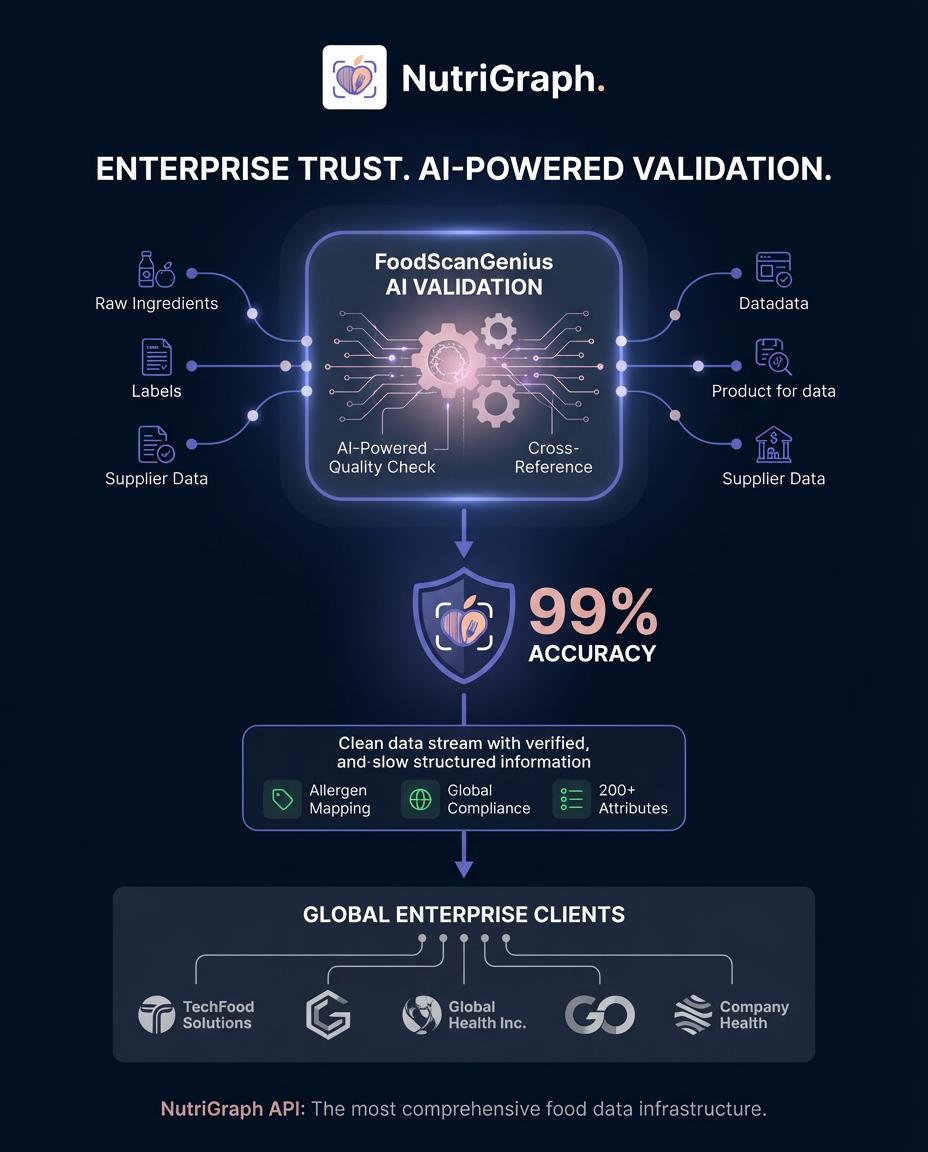
At NutriGraph, our entire data architecture is built on a principle of absolute certainty. We reject the inherent ambiguity of NLP in favor of a deterministic, verifiable data pipeline tethered directly to the physical product’s UPC barcode.
Our process is rigorous and transparent:
- Direct Manufacturer & Retailer Feeds: We ingest data directly from thousands of CPG brands and enterprise grocery partners. This is the ground-truth data, the same information that gets printed on the physical label.
- UPC as the Primary Key: Every single item in our 5 million+ product database is indexed by its UPC. This is a non-negotiable architectural choice. When you query for
049000042566, you are querying for a specific, physical product, not a vague text string like “Coca-Cola Classic 12oz can.” - Multi-Stage Verification: Data is not simply ingested; it’s verified. Our system cross-references manufacturer data with certification databases (e.g., Vegan Action, Certified Vegan) and applies a rules-based engine to flag potential discrepancies. Human auditors provide a final layer of quality assurance for complex cases.
- Optimized Data Structure: The data is stored in a highly structured format, not as blobs of text. Ingredients are tokenized, allergens are mapped to a granular list of over 200 distinct labels, and certifications are stored as discrete boolean flags with associated metadata. This structured approach is what enables complex, multi-faceted queries with predictable performance.
Underpinning this entire system is a database architecture designed for speed. We utilize O(1) B-Tree indexing on the primary UPC key, meaning lookup times are constant and do not degrade as the database grows. For a developer, this translates to predictable, ultra-low latency. Your application’s user experience will be fast and responsive, whether you have 100 users or 10 million.
This is the bedrock of a clinical-grade system. It’s not about guessing; it’s about knowing. When our API returns "is_vegan": true, it is a verifiable statement of fact, not a statistical probability.
NutriGraph vs. The Competition: A Quantitative Analysis
When evaluating a vegan API data provider, marketing claims are irrelevant. Performance metrics and data quality are the only things that matter. Most providers, like Edamam or Spoonacular, are built for consumer recipe blogs and use NLP-based data scraping, which is reflected in their architecture and performance. Here is a direct, quantitative comparison for technical evaluation:
| Feature / Metric | NutriGraph API | Edamam / Spoonacular (Typical) |
|---|---|---|
| Data Source | UPC-Matched, Direct from Manufacturer | NLP-Scraped Web Content, User-Submitted |
| Latency (p95) | < 50ms | 300ms – 1500ms+ |
| Database Size | 5M+ Verifiable UPCs | Unknown / Not Disclosed |
| Allergen Granularity | 200+ Specific Labels (e.g., ‘Casein’, ‘Whey’) | Generic (e.g., ‘Milk’) |
| Vegan Certification | Discrete Boolean + Certification Body Data | Inferred via NLP (High Error Rate) |
| Indexing | O(1) B-Tree on UPC | Full-Text Search on Product Name |
| Rate Limits (Dev Tier) | 1,000 Calls/Day | Variable, Often Lower |
Why These Metrics Are Mission-Critical:
- Latency: A user scanning a barcode in a grocery store aisle will not wait 1.5 seconds for your app to respond. A sub-50ms response from NutriGraph means the information feels instantaneous, which is critical for user retention.
- Allergen Granularity: Simply knowing a product contains “Milk” is insufficient. A user might be specifically allergic to whey but not casein. NutriGraph’s granular data allows you to build sophisticated safety features that competitors simply cannot support.
- UPC-Matching vs. Text Search: Relying on text search for a product introduces a high risk of ambiguity. Is “Ben & Jerry’s Chocolate Fudge Brownie” the dairy version, the non-dairy almond milk version, or the non-dairy sunflower butter version? They have different ingredients but similar names. Only a UPC lookup can provide the correct data with 100% certainty.
Deep Dive: Interacting with the NutriGraph Vegan API Data Endpoints
Our REST API is designed for developer productivity and performance. Endpoints are logical, responses are predictable, and the data is structured for immediate use in your application. Let’s explore the core functionality.
Primary Endpoint: Product Lookup by UPC
The most fundamental operation is retrieving all available data for a specific product using its UPC. This is a simple GET request to our primary product endpoint.
Request:
curl -X GET "https://api.nutrigraphapi.com/v2/product/041196912423" \
     -H "x-api-key: YOUR_DEVELOPER_KEY"
JSON Payload Response:
This request would return a detailed JSON object. Note the structured, unambiguous nature of the vegan and allergen data.
{
  "upc": "041196912423",
  "name": "Almond Breeze Unsweetened Vanilla Almondmilk",
  "brand": "Blue Diamond",
  "dietary_flags": {
    "is_vegan": true,
    "is_vegetarian": true,
    "is_gluten_free": true,
    "is_kosher": true
  },
  "certifications": [
    {
      "name": "Certified Vegan",
      "authority": "Vegan Action",
      "url": "https://vegan.org/certification/"
    }
  ],
  "ingredients_list": "ALMONDMILK (FILTERED WATER, ALMONDS), CALCIUM CARBONATE, NATURAL FLAVORS, SEA SALT, POTASSIUM CITRATE, SUNFLOWER LECITHIN, GELLAN GUM, VITAMIN A PALMITATE, VITAMIN D2, D-ALPHA-TOCOPHEROL (NATURAL VITAMIN E).",
  "allergen_summary": {
    "contains": ["Almonds"],
    "may_contain": [],
    "free_from": ["Dairy", "Soy", "Gluten", "Peanuts"]
  },
  "nutrition_facts": { ... } // Full nutrition label data
}
Advanced Geospatial & Search Queries
Beyond single UPC lookups, you can perform complex queries. For instance, a common use case is finding all products within a specific category that meet multiple dietary criteria.
Example: Find all vegan AND gluten-free ice creams.
curl -X GET "https://api.nutrigraphapi.com/v2/search/products?query=ice%20cream&is_vegan=true&is_gluten_free=true" \
     -H "x-api-key: YOUR_DEVELOPER_KEY"
For restaurant data, our geospatial endpoints allow you to find locations with dedicated vegan menus within a given latitude/longitude and radius, a powerful feature for food discovery apps.
Enterprise Feature: Webhook Integration
For enterprise inventory management or clinical applications tracking specific products, polling our API for updates is inefficient. We provide webhook integration to solve this. You can subscribe to updates for a list of UPCs. If a manufacturer changes an ingredient formulation, causing a product to lose its vegan certification, our system will send a POST request to your specified endpoint with the updated product data payload. This allows you to build event-driven, real-time systems that react instantly to changes in the food supply chain.
Use Cases: Building Mission-Critical Applications on NutriGraph
The quality of NutriGraph’s vegan API data enables use cases that are simply too risky to build on other platforms.
For Health-Tech Founders:
Imagine an allergy management app for parents of children with severe dairy allergies. Using an NLP-based API that might misclassify a product containing whey as “vegan-friendly” is a direct liability. With NutriGraph, you can build an app that scans a UPC and provides an instant, definitive, and verifiable answer on its dairy-free status. This transforms your app from a novelty into a trusted medical tool.
For Enterprise Grocery CTOs:
Your e-commerce platform’s search filters are a core part of the user experience. When a customer filters for “vegan,” they expect 100% accuracy. A single mistake erodes trust and can lead to negative press. By powering your filters with NutriGraph’s UPC-based data, you guarantee accuracy. This same data can power in-store digital shelf labels, mobile app scanners, and even supply chain analytics to track the performance of your vegan product category.
For CPG Analysts:
The market for plant-based foods is exploding. CPG firms need accurate data to understand this trend. Our bulk data export API allows analysts to pull comprehensive data on tens of thousands of products. You can analyze the prevalence of vegan certifications by category, track ingredient trends in plant-based products, and perform competitive analysis with a level of accuracy impossible with scraped web data.
The Final Benchmark: Test Our Vegan API Data Against Your Current Provider
We have discussed the architectural theory, the data pipeline, and the quantitative metrics. But for a developer, the only ground truth is a performance test against your own stack.
We are not asking you to trust our claims. We are challenging you to verify them.
Your current food data provider is likely a bottleneck in your application. Their high latency slows down your user interface. Their data ambiguity forces you to write defensive code and manage the risk of inaccuracy.
We offer a better architecture. A faster, more accurate, and more reliable foundation for your product.
Your next step is simple:
Go to NutriGraphAPI.com. Pull a free, no-commitment 1,000-call developer key. It takes 30 seconds.
Run a head-to-head benchmark. Take 100 UPCs and query them against our API and your current provider’s API. Measure the p95 latency. Compare the richness and accuracy of the JSON response. See the difference between deterministic data and a probabilistic guess.
Build the future of food technology on a foundation of certainty. Start today.