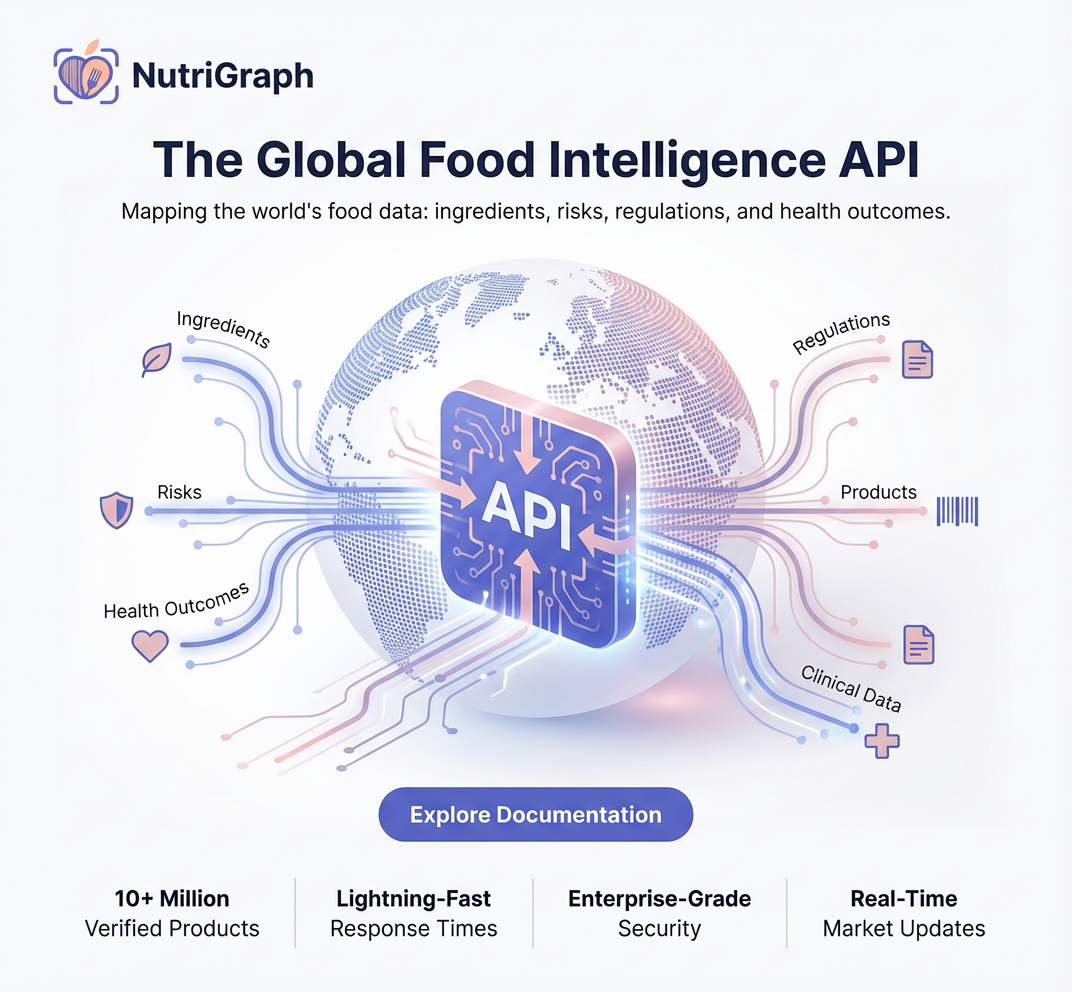
There are over 1.7 million apps on the App Store. A significant number of them are trying to solve the same problem: ‘What’s for dinner?’ Most of them will fail.
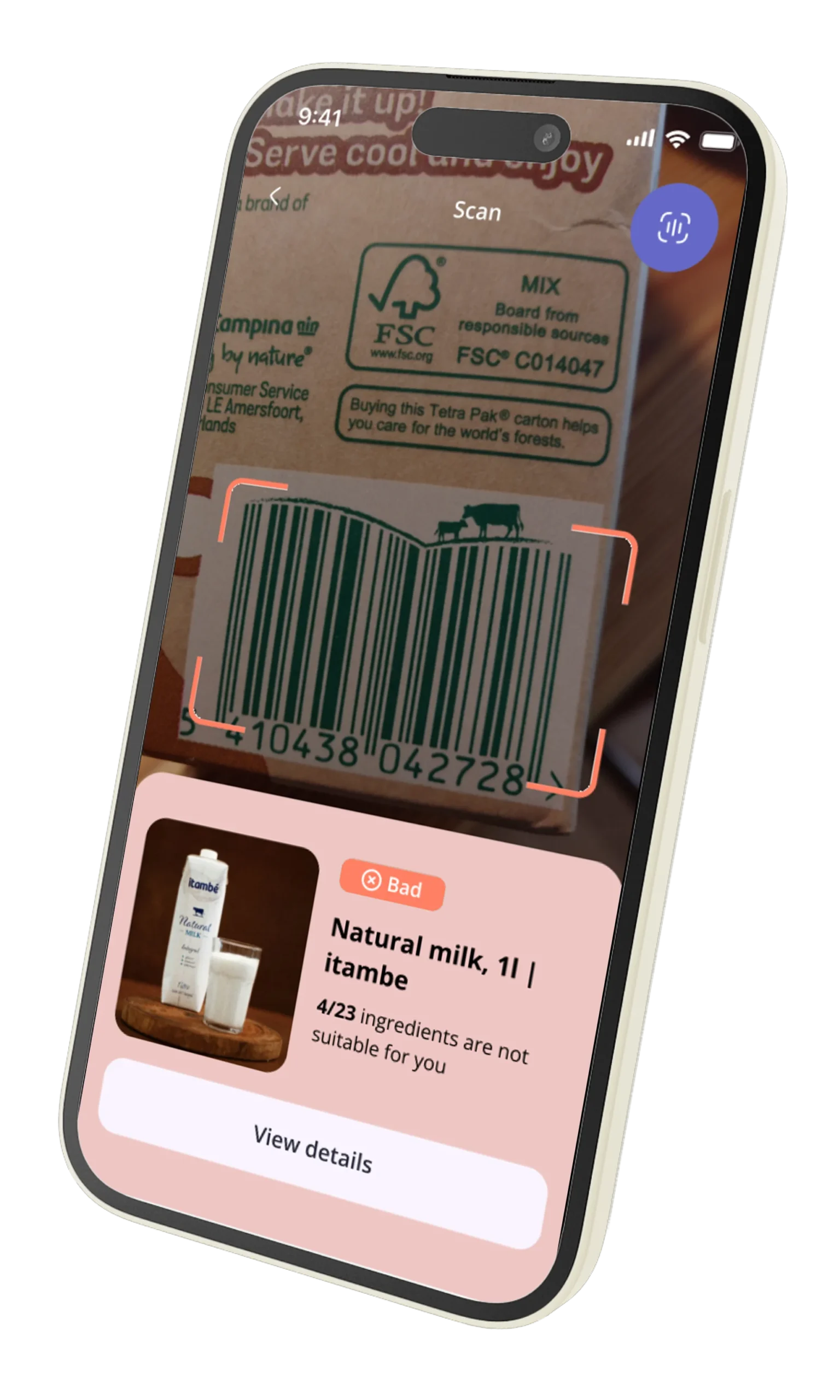
They won’t fail because of a bad UI or a slow backend. They’ll fail because of a crisis of confidence. A user gets a ‘vegan’ recipe with honey. A user with a gluten intolerance gets a recommendation for something made with barley. A parent trying to feed their family healthier food is recommended a meal that’s technically low-calorie but is ultra-processed junk.
Trust, once broken, is gone forever. And in the health-tech space, trust is your only currency.
If you’re a CTO, a lead developer, or a founder scoping the architecture for your meal planning application, you’re at a critical juncture. The food API you choose right now will define the ceiling of your product’s potential. It will dictate whether you build a simple calorie counter or a trusted, indispensable health platform.
You already know you need macronutrients—calories, protein, fat, carbs. That’s table stakes. It’s what the other 99 apps are doing. But the market isn’t won by meeting expectations; it’s won by anticipating the needs your users haven’t even articulated yet. It’s about seeing the future and building for it now.
This isn’t just a guide to choosing a food API. This is a blueprint for building a product that lasts. Let’s talk about the data you actually need.
What Data a Meal Planning App Actually Needs (Beyond Basic Macros)
Every food API, including basic ones like Spoonacular, can give you the ‘big four’: calories, protein, carbohydrates, and fats. This is the nutritional equivalent of knowing a car’s color and number of doors. It’s descriptive, but it tells you nothing about the quality of the engine, the safety rating, or the fuel efficiency.
To build a platform that genuinely improves health outcomes, you must go deeper. Your data layer is the foundation of your user’s trust.
The Foundational Layer: Advanced Macronutrient Data
Beyond a simple total, your users need a breakdown. It’s not just ‘fat,’ it’s:
- Saturated Fat: Critical for heart health metrics.
- Polyunsaturated Fat: Important for brain function.
- Monounsaturated Fat: Key in diets like the Mediterranean diet.
- Trans Fat: A hard ‘avoid’ for any health-conscious user.
It’s not just ‘carbohydrates,’ it’s:
- Dietary Fiber: Essential for digestive health.
- Sugars (Total and Added): The distinction between sugars in an apple and added high-fructose corn syrup is one of the most important metrics for modern health.
- Net Carbs: Non-negotiable for any app targeting the massive Keto and low-carb market.
The Next Level: Micronutrients and Glycemic Data
This is where you graduate from a calorie counter to a nutrition tool. Micronutrients are the vitamins and minerals that govern everything from energy levels to immune response. A user trying to manage anemia needs to track iron. Someone focused on bone density needs calcium and Vitamin D. Your API must provide comprehensive micronutrient profiles, including:
- Vitamins: A, C, D, E, K, and the B-complex vitamins (B1, B2, B3, B5, B6, B7, B9, B12).
- Minerals: Calcium, Iron, Magnesium, Potassium, Sodium, Zinc, and more.
Furthermore, for a huge segment of the population managing diabetes, pre-diabetes, or simply their energy levels, Glycemic Index (GI) and Glycemic Load (GL) are more important than calorie counts. These metrics measure how quickly a food raises blood sugar levels. Recommending a ‘low-calorie’ meal with a high GI can be actively harmful to these users. An intelligent API provides this data per ingredient and per recipe.
The Strategic Differentiator: Ingredient-Level Provenance
Where does the data come from? A generic entry for ‘apple’ is useless. Is it a Red Delicious or a Granny Smith? Is it organic? Is the data from a verified government database like the USDA’s FoodData Central, or is it user-submitted and prone to error? A premium API provides source-level attribution for its data, allowing you to build a product on a foundation of verifiable truth.
Dietary Restriction Handling: Vegan, Keto, Paleo, Low-FODMAP, and What the API Needs to Return
Handling dietary restrictions is the first major test of your data’s integrity. A simple boolean flag isVegan: true is an invitation to disaster. These are not simple tags; they are complex, rule-based systems of inclusion and exclusion.
Your user doesn’t care about your boolean flags. They care about the fact that you just recommended a ‘vegan’ soup that was thickened with gelatin or a ‘keto’ snack bar sweetened with maltitol, which can spike blood sugar.
An enterprise-grade food API doesn’t just return a label. It returns the reasoning. Here’s what your API response needs to contain for a few of the most common, and complex, diets:
-
Vegan/Vegetarian: It’s not just ‘no meat’. A robust check includes flagging hidden animal products like casein, whey, gelatin, honey, carmine, and certain forms of Vitamin D3. The API should be able to distinguish between ovo-lacto vegetarian, lacto-vegetarian, and strict vegan.
-
Keto/Low-Carb: This requires precise calculation of Net Carbs (Total Carbs – Fiber – certain sugar alcohols). The API needs to have a sophisticated understanding of different sweeteners and their metabolic impact. A simple total carb count is a recipe for kicking your users out of ketosis.
-
Paleo: This is more than low-carb. It requires the exclusion of entire food groups: grains, legumes, dairy, refined sugars, and processed oils. Your API needs a deep ingredient ontology to correctly identify and flag a product containing, for example, soybean oil or wheat flour.
-
Low-FODMAP: This is arguably one of the most complex therapeutic diets, crucial for users with IBS. It involves excluding specific types of fermentable carbs (Fermentable Oligosaccharides, Disaccharides, Monosaccharides, and Polyols). This is impossible to manage without a database that has analyzed ingredients at a chemical level. Your API needs to identify high-FODMAP ingredients like garlic, onions, high-fructose corn syrup, and lactose with pinpoint accuracy.
For each of these, your API shouldn’t just return a pass/fail. It should provide a compatibility object, detailing which ingredients pass, which fail, and why. This allows you to build a user experience that educates, not just dictates.
Allergen Exclusion: Why “Contains Peanuts” Isn’t Enough
When you handle food allergies, you are operating in a domain with zero tolerance for error. The legal and moral liability is immense. The phrase “contains peanuts” is the bare minimum, the elementary school version of allergen data.
A professional health platform needs to account for the nuances that can mean the life or death of its users.
Cross-Contamination Warnings
The most significant gap in basic food APIs is the lack of data on cross-contamination. A product can be free of peanut ingredients but manufactured on the same equipment as peanut butter. For someone with a severe allergy, this is a distinction that matters. Your API must parse and return explicit manufacturer warnings like:
"Processed in a facility that also handles tree nuts.""May contain traces of wheat and soy."
Without this, you are exposing your users to unacceptable risk and your company to significant liability.
Ingredient Derivatives
Allergens are masters of disguise. A user allergic to soy needs to avoid not just tofu, but also soy lecithin. A user with a corn allergy needs to be wary of xanthan gum, which is often derived from corn. A dairy allergy extends to whey, casein, and lactose.
Your API needs a sophisticated ingredient graph that understands these relationships. It must be able to flag a product containing ‘soy lecithin’ when a user specifies a ‘soy’ allergy. A simple string match on an ingredient list is dangerously inadequate.
The ‘Big 9’ and Beyond
The FDA requires labeling for the nine major allergens (sesame was added in 2023). But a global app needs a global perspective. What about mustard in Canada or lupin in Europe? A truly capable API provides configurable allergen profiles based on region and goes far beyond the basics to include common intolerances like gluten, sulfites, and more.
Quality Scoring for Meal Recommendations: Nutri-Score, NOVA, Health Star Rating
Your users don’t just want meals that fit their macros. They want better meals. They want to make healthier choices. How do you, as an app developer, quantify ‘healthy’?
This is where objective, science-backed quality scores become a powerful tool for product differentiation. Instead of making your users guess, you can show them a simple, color-coded rating. This transforms your app from a data log into a decision engine.
Leading food APIs integrate these global standards:
-
Nutri-Score: Widely adopted in Europe, this front-of-pack label grades food from ‘A’ (best) to ‘E’ (worst) based on a scientific formula that balances positive nutrients (fiber, protein) against negative ones (sugar, sodium, saturated fat). It provides an at-a-glance quality assessment.
-
NOVA Classification: This system from Brazil is becoming the global standard for classifying food by its level of processing. It has four categories:
- NOVA 1: Unprocessed or minimally processed foods (e.g., fresh fruit, eggs).
- NOVA 2: Processed culinary ingredients (e.g., olive oil, butter).
- NOVA 3: Processed foods (e.g., canned vegetables, simple bread).
- NOVA 4: Ultra-processed foods (e.g., soda, packaged snacks, most ready-to-eat meals).
Research increasingly links high consumption of NOVA 4 foods to poor health outcomes. Providing this score empowers your users to reduce their intake of ultra-processed products, a goal that goes far beyond simple calorie counting.
-
Health Star Rating: Used in Australia and New Zealand, this system rates products from 0.5 to 5 stars, providing another simple visual cue for healthier choices.
Integrating these scores allows you to build features like ‘Suggest a healthier swap’ or ‘Show me only NOVA 1-3 meals’. This is a level of sophistication that commodity APIs like Spoonacular simply can’t offer. You’re no longer just providing recipes; you’re providing nutritional guidance.
Religious Dietary Compliance: Halal, Kosher, Jain, Hindu – The Overlooked Requirement
For billions of people, food choices are guided by deeply held religious and cultural beliefs. For these users, a meal planning app that ignores their needs isn’t just unhelpful; it’s disrespectful. This is a massively underserved market, and the technical partner you choose will determine if you can even enter it.
Handling this requires far more than flagging ‘pork’.
-
Halal: It’s not just about avoiding pork and alcohol. It extends to the method of slaughter (Zabihah) and the complete absence of contamination from non-Halal substances. This requires data from certified Halal products, not just ingredient guesswork.
-
Kosher: Like Halal, this involves a complex set of laws regarding which foods can be consumed and how they must be prepared. It requires identifying certifications from recognized bodies (e.g., OU, OK, KOF-K) and understanding rules like the separation of meat and dairy.
-
Jain: This vegetarian diet has even stricter rules, excluding root vegetables (like onions and garlic) and other ingredients that involve harming the entire plant.
-
Hindu: While many Hindus are vegetarian, many are not but will still abstain from beef. An app must be able to accommodate this specific exclusion.
To service these users, your API can’t rely on inference. It needs a database that explicitly tracks certifications and has a data model capable of representing these complex rules. When you can confidently serve a user searching for ‘Certified Halal, gluten-free, low-carb meal ideas,’ you are operating in a different league from your competitors. You’re not just building an app; you’re building a tool for inclusive, global wellness.
How NutriGraphAPI Covers All of This in a Single API Call
We’ve just outlined a staggering level of data complexity. The traditional approach would be to stitch together multiple services: one API for basic nutrition, another for allergen data (if you can find it), a scraped database for dietary rules, and a team of nutritionists to manually curate and verify everything.
The engineering overhead, cost, and data inconsistency of that approach will kill your product before it ever finds product-market fit.
This is the problem NutriGraph was built to solve. We believe that world-class data should be an accelerant, not an obstacle. We’ve done the painstaking work of aggregating, verifying, and structuring this data so you can focus on what you do best: building an incredible user experience.
With NutriGraph, you can retrieve a complete, multi-faceted nutritional profile for any food item or recipe in a single, elegantly structured API call. One request gives you:
- Comprehensive Macro & Micro-Nutrient Profiles: From net carbs to Vitamin K, with data sourced from verified government and manufacturer databases.
- Deep Dietary Analysis: Not just a boolean, but a detailed breakdown for Vegan, Keto, Paleo, Low-FODMAP, and dozens of other diets.
- Certified Allergen & Intolerance Data: Including cross-contamination warnings and derivative ingredient mapping.
- Objective Quality Scores: Nutri-Score, NOVA classification, and Health Star Rating are returned as standard fields.
- Verifiable Religious Compliance: Data on Halal and Kosher certifications from trusted authorities.
Stop thinking about how to integrate a half-dozen mediocre data sources. Start thinking about the powerful, personalized, and trustworthy features you can build on a foundation of a single, definitive source of truth.
Sample Response Walkthrough
Talk is cheap. Let’s look at the data. Here is a sample JSON response from a NutriGraph API query for a single product. Notice how every concern we’ve discussed—from micronutrients to NOVA scores to Halal certification—is present, structured, and ready to use.
{
  "id": "ng_8a2b4e7c1f0d",
  "productName": "Organic Chickpea & Spinach Curry",
  "servingSize": {
    "value": 250,
    "unit": "g"
  },
  "nutritionFacts": {
    "calories": 320,
    "macronutrients": {
      "protein": {"value": 14, "unit": "g"},
      "fat": {
        "total": {"value": 12, "unit": "g"},
        "saturated": {"value": 3, "unit": "g"},
        "polyunsaturated": {"value": 4, "unit": "g"},
        "monounsaturated": {"value": 5, "unit": "g"},
        "trans": {"value": 0, "unit": "g"}
      },
      "carbohydrates": {
        "total": {"value": 38, "unit": "g"},
        "fiber": {"value": 10, "unit": "g"},
        "sugars": {"value": 6, "unit": "g"},
        "addedSugars": {"value": 2, "unit": "g"},
        "netCarbs": 28
      }
    },
    "micronutrients": [
      {"name": "Iron", "amount": {"value": 4, "unit": "mg"}, "percentDailyValue": 22},
      {"name": "Potassium", "amount": {"value": 650, "unit": "mg"}, "percentDailyValue": 15},
      {"name": "Vitamin C", "amount": {"value": 30, "unit": "mg"}, "percentDailyValue": 33}
    ],
    "glycemicIndex": 35
  },
  "qualityScores": {
    "nutriScore": "A",
    "novaClassification": 3,
    "healthStarRating": 4.5
  },
  "dietaryCompliance": [
    {
      "diet": "Vegan",
      "isCompliant": true,
      "reasoning": "Contains no animal-derived ingredients. All components are plant-based."
    },
    {
      "diet": "Keto",
      "isCompliant": false,
      "reasoning": "Net carbs (28g) exceed typical ketogenic daily limits for a single serving."
    }
  ],
  "allergenInfo": {
    "contains": [],
    "warnings": [
      "Processed in a facility that also handles tree nuts and sesame."
    ],
    "freeFrom": ["Gluten", "Dairy", "Soy", "Peanuts"]
  },
  "religiousCompliance": {
    "halal": {
      "isCompliant": true,
      "certificationBody": "IFANCA",
      "status": "Certified"
    },
    "kosher": {
      "isCompliant": true,
      "certificationBody": "OU",
      "status": "Certified Pareve"
    }
  },
  "dataSource": "USDA FoodData Central, Manufacturer Direct"
}
This is what a foundation for trust looks like. It’s clean, comprehensive, and built for the serious developer.
Your meal planning app has the potential to be a trusted partner in your users’ health journey. But that trust depends entirely on the quality of the data you feed it. Don’t build your future on a foundation of incomplete, unreliable, or superficial information.
Choose the API that was built for the complexities of modern nutrition and global audiences. Choose the data layer that will scale with your ambition.
Explore the schema at nutrigraphapi.com/docs and pull a 1,000-call developer key. See for yourself what a real food API can do.”,
“json_ld_faq_schema”:
},
{
“@type”: “Question”,
“name”: “What is the technical difference between a food quality score like Nutri-Score and a simple calorie count?”,
“acceptedAnswer”: {
“@type”: “Answer”,
“text”: “A calorie count is a single, raw data point. A quality score like Nutri-Score is a calculated, composite metric based on a scientific algorithm. The Nutri-Score formula algorithmically weighs ‘negative’ components (energy, saturated fats, sugars, sodium) against ‘positive’ components (fiber, protein, percentage of fruits/vegetables/nuts). The API performs this calculation on the backend, returning a simple A-E grade. This provides contextual insight into the overall healthfulness of a food, which a calorie count alone cannot do.”
}
},
{
“@type”: “Question”,
“name”: “How can an API endpoint filter recipes by multiple, complex dietary needs like ‘Vegan’ and ‘Low-FODMAP’ simultaneously?”,
“acceptedAnswer”: {
“@type”: “Answer”,
“text”: “An effective API allows for complex filtering through query parameters. For example, a request might look like GET /recipes?diet=vegan&diet=low_fodmap. On the backend, the system must have pre-computed or be able to compute in real-time the compliance of each recipe against both rule sets. This requires a robust data model where each ingredient is tagged with its properties (e.g., FODMAP level, animal-derived status). The API then filters the recipe database, returning only recipes where all ingredients satisfy the constraints of both specified diets.”
}
},
{
“@type”: “Question”,
“name”: “Does a food API need to provide sourcing information for Halal or Kosher certification?”,
“acceptedAnswer”: {
“@type”: “Answer”,
“text”: “Yes, for a platform to be considered trustworthy by users following religious diets, simply stating ‘isHalal: true’ is insufficient. A professional-grade API must provide provenance for the claim. The JSON response should include fields specifying the certification body (e.g., OU for Kosher, IFANCA for Halal) and the status (e.g., Certified, Pareve). This data allows the application to display verifiable proof of compliance, building critical user trust that cannot be achieved with a simple, unsubstantiated flag.