The Conversation About Food Data is Stale. Let’s Change It.
There’s a moment in every ambitious project where you hit a wall. For developers and founders in the health-tech space, that wall is often made of data. You have a vision for a truly personalized, clinically-aware, and deeply insightful nutrition application. You go looking for the right tool, the right data source, and what do you find? A landscape of compromises.
You find APIs that treat ‘allergens’ as a simple boolean. You find databases that are a mile wide and an inch deep, cobbled together from user-submitted data with the consistency of a potluck dinner. You’re forced to choose between a recipe parser and granular ingredient analysis, but you can’t have both. You’re building a rocket ship, and you’re being handed a wrench from a 1970s toolkit.
This isn’t just a technical problem; it’s a failure of imagination. The current crop of food APIs—Spoonacular, Edamam, Nutritionix—are products of a bygone era. They were built to answer a simple question: “What’s in this food?” They were never designed to answer the questions that matter now: “Is this food truly safe for me? Is it aligned with my specific health protocol? Will it cause an inflammatory response? Is it ‘clean’?”
If you’re tired of building your future on a foundation of ‘good enough,’ you’re in the right place. This isn’t another superficial listicle. This is a brutally honest, technically-grounded teardown of the best food APIs for developers in 2026. We’ll dissect the major players, expose their limitations, and show you what becomes possible when you stop thinking about food data and start demanding food intelligence.
What to Look For in a Food Data API: The CTO’s Checklist
Choosing a food data API isn’t just a line item on your budget; it’s a foundational architectural decision. Your data partner dictates your product roadmap, your user’s trust, and your ability to create a defensible moat around your business. Before we compare names, let’s agree on the criteria that separate a utility from a strategic asset.
1. Data Granularity & Attribute Depth:
This is the most critical factor. Basic APIs provide macros (fat, protein, carbs), a handful of micros, and maybe a top-level allergen warning. This is table stakes. A modern, intelligent API must provide an order of magnitude more depth.
- Allergen Granularity: Does it just flag ‘nuts,’ or does it differentiate between peanuts, tree nuts, and specific sub-allergens? Does it track the EU 14, the FDA 9, or a more comprehensive, global list? Does it account for cross-contamination warnings (‘may contain’)?
- Dietary & Lifestyle Attributes: How deep does it go beyond ‘vegan’ or ‘gluten-free’? Can it identify Paleo, Keto, Low-FODMAP, or AIP-compliant products? What about religious compliance like Kosher, Halal, or Jain?
- Ingredient Intelligence: Does the API simply list ingredients, or does it analyze them? Can it flag artificial sweeteners, preservatives, inflammatory oils, or other additives that fall under the ‘clean label’ umbrella?
2. Data Sourcing & Accuracy:
Where does the data come from? An API is only as good as its source of truth. Many popular APIs rely heavily on crowd-sourcing or scraping, leading to a high signal-to-noise ratio, outdated information, and a lack of accountability. Look for providers who source data directly from manufacturers, employ rigorous verification processes, and can stand behind their data’s accuracy. Your liability as a health-tech company depends on it.
3. API Performance & Developer Experience:
* Response Time (Latency): In a mobile-first world, every millisecond counts. An API that takes 500ms+ to respond will kill your user experience. Demand latency under 100ms for core lookups.
* Scalability & Rate Limits: Will the API grow with you? Are the rate limits generous and the overage policies clear? You don’t want your growth to be throttled by your data provider’s infrastructure.
* Documentation & SDKs: Is the documentation clear, comprehensive, and filled with real-world examples? Are there SDKs for your preferred language? A great developer experience accelerates your time-to-market.
4. The Pricing Model:
It’s not just about the cost per call. It’s about value and predictability.
- Per-Call vs. Tiered: Does the model punish you for scaling? Are there massive jumps between tiers?
- Transparency: Are enterprise plans a black box requiring endless sales calls? Or is the pricing clear and upfront?
- Value: What is the cost per attribute? An API that charges $0.01 per call for 20 data points is exponentially more expensive than one that charges $0.02 for 200+ data points. You’re not buying calls; you’re buying answers.
With this framework in mind, let’s put the industry’s biggest names under the microscope.
Spoonacular: The Crowd-Sourced Behemoth
Spoonacular is often the first stop for developers. It’s massive. With over 2 million recipes and 500,000+ CPG products, its scale is impressive. But this scale is its greatest strength and its most profound weakness.
Strengths:
* Vast Recipe Database: If your primary use case is recipe search, parsing, and discovery, Spoonacular is a functional starting point. Its recipe parsing and meal planning endpoints are mature.
* Broad Feature Set: It tries to be everything to everyone, with endpoints for recipe generation, menu planning, wine pairing, and more. It’s a Swiss Army knife.
Limitations:
* Data Quality is a Gamble: Much of Spoonacular’s data is user-generated or scraped. This means you’ll find inconsistencies, inaccuracies, and outdated information. For a consumer recipe blog, this might be acceptable. For a health-tech app managing a user’s severe peanut allergy, it’s a lawsuit waiting to happen.
* Shallow Nutritional Depth: Beyond basic macros and a few vitamins, the data is thin. Its allergen detection is rudimentary, often a simple boolean flag, lacking the granularity to distinguish between ‘contains’ and ‘may contain.’
* Slow Response Times: The ‘everything but the kitchen sink’ approach leads to a complex, monolithic API. It’s not uncommon to see response times exceeding 500ms, especially for complex queries. This is a UX killer.
* The Swiss Army Knife Problem: While it does many things, it excels at none of them. The product data is less reliable than dedicated CPG APIs, and the nutritional analysis is less rigorous than clinical-grade alternatives.
Pricing:
Spoonacular uses a points-based system that can be confusing. Different endpoints cost different numbers of points. It’s a classic freemium model designed to get you hooked on the free plan and then upsell you to paid tiers that can quickly become expensive as you scale. Their enterprise pricing is opaque.
Verdict: A good tool for hobby projects, recipe bloggers, or applications where data accuracy is not mission-critical. It’s a jack-of-all-trades, master of none. If you’re building a serious health or wellness application, relying on Spoonacular’s data is like building on sand.
Edamam: The Recipe & NLP Specialist
Edamam has carved out a strong niche with its powerful Natural Language Processing (NLP) and recipe analysis capabilities. It’s trusted by major brands and has a reputation for quality in its specific domain.
Strengths:
* Best-in-Class NLP: Edamam’s Nutrition Analysis API is excellent at taking a raw ingredient list (e.g., “a cup of flour, two large eggs, and a dash of vanilla”) and returning detailed nutritional information. This is its core competency.
* Solid Recipe Database: Its recipe search API is well-structured and provides reliable data for a large corpus of recipes.
* Established & Trusted: They’ve been around for a while and power some big names, which provides a degree of trust and stability.
Limitations:
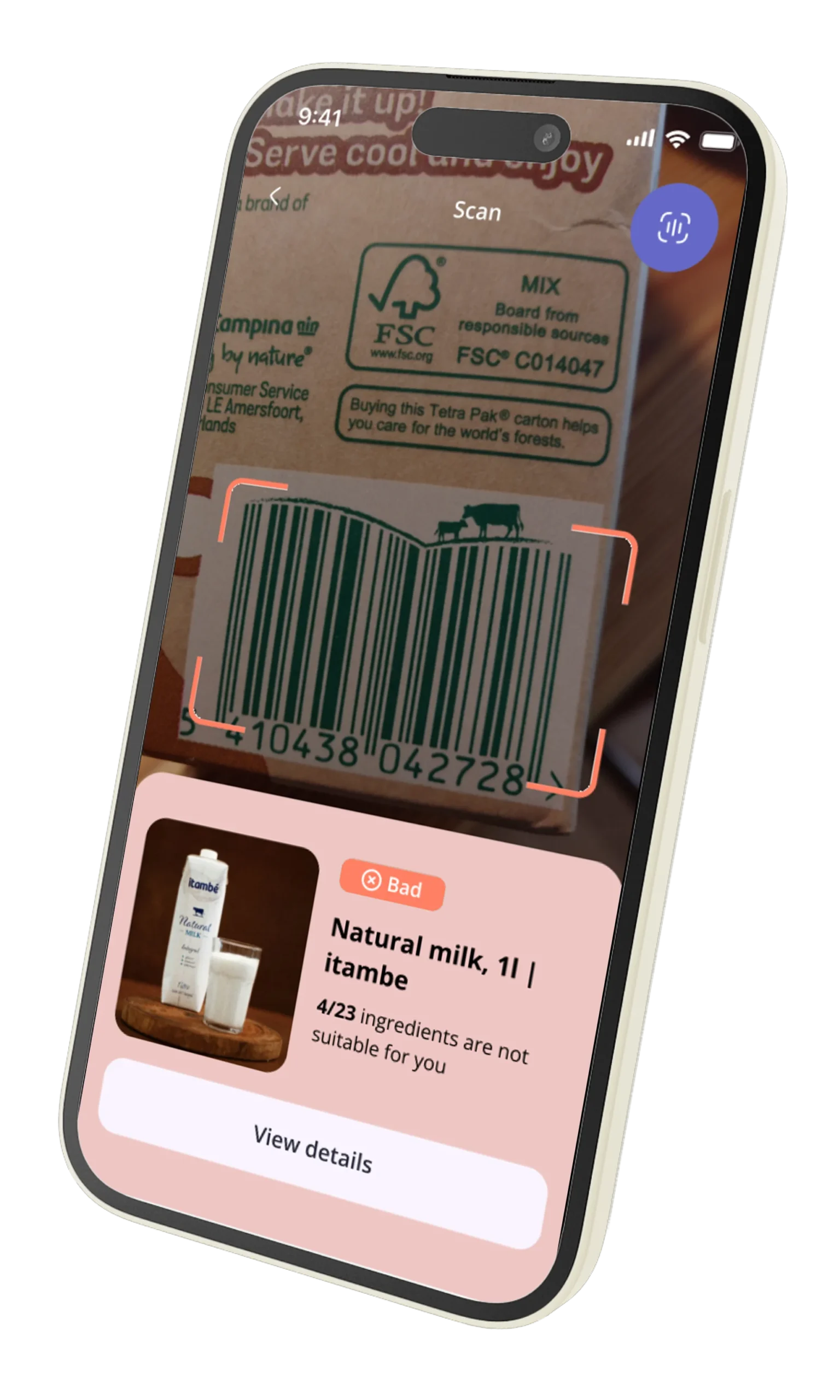
* Limited CPG/Barcode Coverage: While strong on recipes, Edamam’s database of branded, packaged food products (accessed via UPC) is significantly smaller than its competitors. If your app relies on barcode scanning, this is a major gap.
* Surface-Level Allergen & Dietary Data: Similar to Spoonacular, the depth is lacking. It provides standard health labels (‘Vegan’, ‘Paleo’) and allergen information that covers the basics but lacks the deep granularity needed for complex dietary management. Concepts like ‘clean label’ or advanced inflammatory triggers are not part of their data model.
* Pricing Model Punishes Data Depth: Edamam’s pricing is often tied to the number of nutrients you request per food. Want more than the basic macros? The cost per call goes up. This model actively discourages developers from building data-rich experiences.
Pricing:
Edamam offers several APIs (Recipe Search, Nutrition Analysis, etc.) each with its own pricing structure. Tiers are based on API calls per month, with significant overage charges. The model that charges per nutrient can make cost forecasting difficult and expensive.
Verdict: If your application’s core function is analyzing user-submitted recipes or unstructured ingredient lists, Edamam is a strong contender. However, for applications focused on CPG product data, barcode scanning, and deep dietary intelligence, its limitations become apparent very quickly.

Nutritionix: The Food Service & Restaurant Expert
Nutritionix began with a focus on restaurant and food service data, and this remains its core strength. Their NLP is tuned for restaurant menu items and they boast a massive database of what you’ll find when eating out.
Strengths:
* Unmatched Restaurant Database: They have nutritional information for close to a million restaurant menu items. If your app is a calorie or macro tracker for people who eat out frequently, Nutritionix is hard to beat.
* Strong Natural Language API: Their NLP is excellent for queries like “a large coffee with cream and two sugars at Starbucks” or “a Big Mac combo.”
* Trusted by Major Brands: Like Edamam, they have a strong enterprise client list, particularly in the corporate wellness and restaurant space.
Limitations:
* Weaker on CPG/Grocery Data: While they have a CPG database, it’s not their primary focus. The depth and verification process can’t match a provider that is singularly focused on grocery products.
* Dated Data Model: The API primarily serves up basic nutrition facts panel data. It lacks the rich, modern attributes that users now demand: clean label scoring, detailed allergen sub-classes, sustainability scores, or religious compliance.
* Enterprise-Focused: The platform and pricing feel heavily geared towards large enterprise clients. For startups and mid-size companies, navigating their offerings and getting support can be more challenging compared to more developer-centric platforms.
Pricing:
Nutritionix has a free starter plan, but its paid plans ramp up quickly and are clearly aimed at large-scale B2B customers. Getting a quote for high-volume usage requires a conversation with their sales team.
Verdict: The go-to choice for applications centered on dining out and restaurant food tracking. For health-tech companies building next-generation grocery shopping, meal planning, or clinical nutrition apps, Nutritionix’s data model feels a decade old.
Open Food Facts: When Free is Fine (And When It’s a Liability)
We have to mention Open Food Facts. It’s an open-source, crowd-sourced database, and it’s free. For students, hackathons, or non-commercial projects, it’s a fantastic resource.
When It’s Fine:
* Building a personal project or a proof-of-concept.
* When 100% data accuracy is not a requirement.
* When your budget is zero and you have the developer resources to clean and validate the data yourself.
When It’s Not:
* Commercial Applications: Relying on unverified, crowd-sourced data for a commercial product is a massive business risk. What happens when a user with a celiac diagnosis scans a product that was incorrectly tagged as gluten-free by a random contributor?
* Data Consistency: The data is notoriously inconsistent. Some products have rich data, others have nothing but a name. There’s no SLA, no one to call when the data is wrong, and no guarantee of uptime.
* Lack of Depth: While it has some interesting fields like the Nutri-Score, it lacks the structured, deep attributes of a commercial-grade API.
Verdict: A valuable community project and a great starting point for exploration. But for any business that takes its users’ health seriously, building on Open Food Facts is like building a hospital on a volunteer-run foundation. It’s a question of ‘when,’ not ‘if,’ it will fail you.
NutriGraphAPI: Where 200+ Attributes Changes What’s Possible
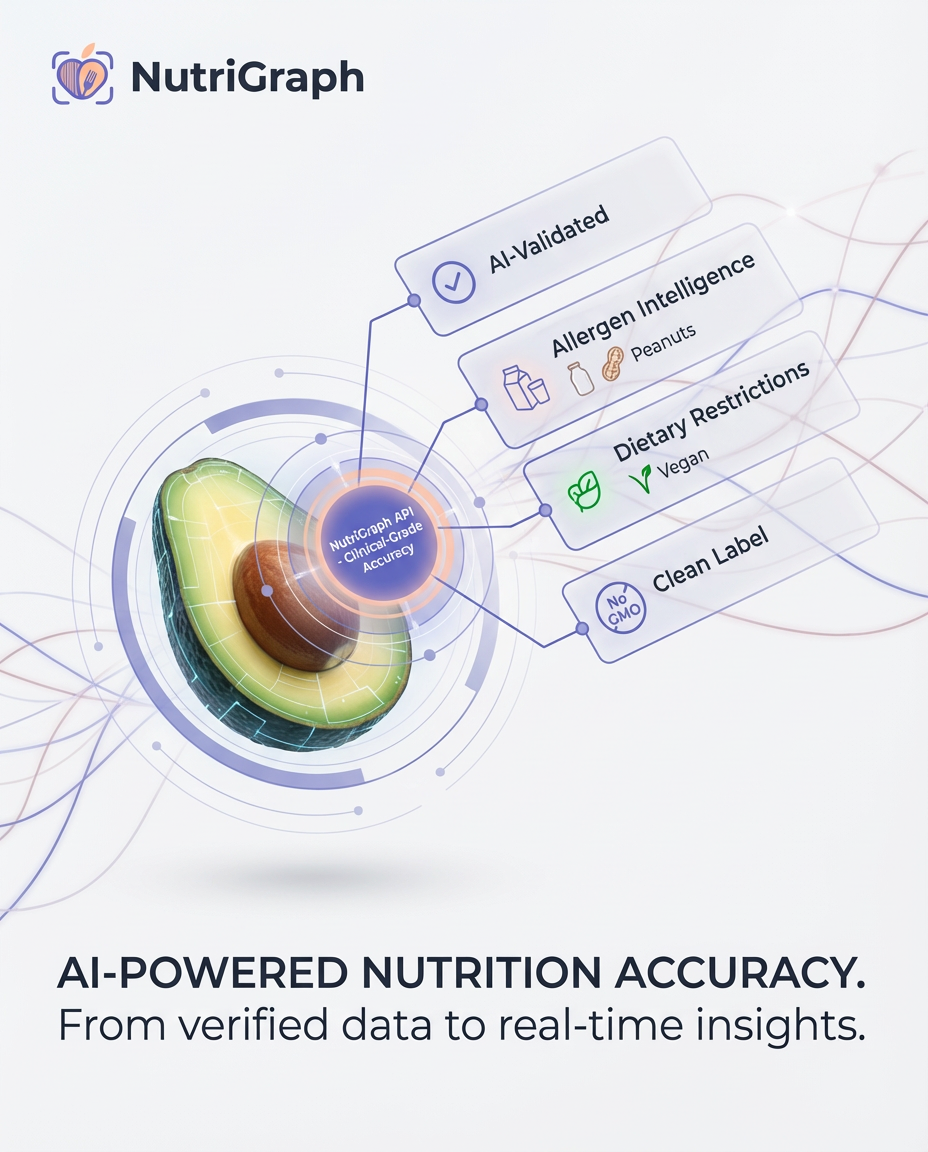
This brings us to a different way of thinking. NutriGraphAPI was built on a simple, powerful premise: the old model of food data is broken. A modern nutrition app doesn’t need a list of 20 nutrients; it needs a comprehensive, verified, and deeply interconnected graph of food intelligence. It needs to understand food the way a clinical nutritionist does.
We didn’t build another food data API. We built a food intelligence platform. The difference is in the depth.
Where We Are Radically Different:
* Unrivaled Granularity (200+ Attributes Per Product): This is our foundation. We don’t just track the basics. We track 39+ allergens and sub-allergens, including cross-contamination risks. We score products for compliance with 20+ diets (Keto, Paleo, Low-FODMAP, AIP, etc.). We analyze every single ingredient to assign quality scores and flag over 100 additives, preservatives, inflammatory agents, and more.
* Clean Label & Quality Scoring: We’re the only API that provides objective, algorithm-driven ‘Clean Label’ and ‘Food Quality’ scores. This allows you to move beyond calories and empower users to understand how a food is made, not just what’s in it.
* Source of Truth: Our data isn’t scraped or crowd-sourced. We have a multi-layered verification process that starts with manufacturer-submitted data and is enriched by a team of nutritionists and data scientists. We stand behind our data because we own the entire pipeline.
* Blazing Fast Performance: Our API is built on a modern, multi-cloud infrastructure designed for speed and scale. Our median response time is under 75ms, ensuring a fluid and responsive user experience in your application.
* Religious Dietary Compliance: We provide detailed compliance data for Halal, Kosher, Jain, and Hindu (Vegetarian/Lacto-Vegetarian) diets, opening up new markets and use cases that are impossible with other providers.
What This Unlocks for You:
* For the CTO: You’re building on a reliable, scalable, and future-proof platform. You reduce technical debt by eliminating the need to build your own complex data cleaning and analysis pipelines. Our rich dataset allows your team to build features your competitors can’t even conceive of.
* For the Lead Developer: You get a clean, well-documented REST API, predictable performance, and data that is structured, consistent, and immediately usable. No more endless data cleaning scripts. You can focus on building features, not wrestling with bad data.
* For the Founder: You create a defensible moat. While your competitors are still arguing about basic macros, you can offer users truly personalized insights: “Here are 5 snack bars that are not only gluten-free, but also free from inflammatory seed oils and compliant with your Paleo lifestyle.” You reduce liability, increase user trust, and build a product people will pay for.
The Ultimate Comparison Table: Data vs. Intelligence
Let’s put it all on the table. No marketing spin, just the facts.
| Feature | Spoonacular | Edamam | Nutritionix | NutriGraphAPI |
|---|---|---|---|---|
| Core Strength | Recipe Database | Recipe NLP | Restaurant Data | CPG Product Intelligence |
| Allergen Fields | Basic (e.g., ‘contains peanuts’) | Basic (FDA/EU list) | Basic | 39+ Allergens & Cross-Contamination |
| Dietary Tags | ~10 common diets (Vegan, Gluten-Free) | ~15 common diets | Very limited | 20+ Diets (Keto, Paleo, FODMAP, AIP, etc.) |
| Religious Compliance | ❌ No | ❌ No | ❌ No | ✅ Halal, Kosher, Jain, Hindu |
| Clean Label Analysis | ❌ No | ❌ No | ❌ No | ✅ Flags 100+ additives, preservatives, seed oils |
| Objective Quality Score | ❌ No | ❌ No | ❌ No | ✅ Proprietary Food Quality Score |
| Data Source | Crowd-sourced, Scraped | Partnered, Scraped | Food Service, Partnered | Direct from Manufacturer, Human-Verified |
| Barcode/UPC Lookup | ✅ (Variable Quality) | ⚠️ (Limited Database) | ✅ (Restaurant-focused) | ✅ (Comprehensive & Verified) |
| Median Response Time | ~400-600ms | ~250-400ms | ~300-500ms | <75ms |
| Pricing Model | Confusing points system | Per-call, per-nutrient | Opaque Enterprise Tiers | Transparent, Value-based Tiers |
Which API Is Right for Your Use Case?
Choosing the right tool for the job is everything.
-
If you’re building a simple recipe blog or a hobbyist calorie counter…
Spoonacular or even Open Food Facts might be sufficient. Your need for data accuracy and depth is low, and you can tolerate inconsistencies. -
If your app’s main feature is analyzing user-submitted recipe text…
Edamam’s NLP is purpose-built for this and is likely your best choice. -
If you’re building a tool to track calories while dining out…
Nutritionix has the most comprehensive database of restaurant menu items and is the clear leader here. -
If you are building a next-generation health-tech platform, a clinical nutrition app, a personalized grocery shopping guide, an allergy management tool, or any application where data accuracy, depth, and user trust are paramount…
The choice is clear. The limitations of the other APIs become liabilities. You need the granular, verified, and intelligent data that only NutriGraphAPI provides. You’re not just logging food; you’re changing lives. You need a partner whose data is as serious as your mission.
Stop Compromising. Start Building.
The health-tech landscape is littered with apps that look the same because they’re all built on the same limited data. You have an opportunity to build something different. Something smarter. Something that creates real, lasting value for your users.
But you can’t build the future on yesterday’s tools.
It’s time to demand more from your data. See for yourself what’s possible when you have access to a true food intelligence platform.
See how NutriGraphAPI stacks up on price and pull your Free 1,000-Call Sandbox Key.