A CTO’s Guide to Edamam, Spoonacular, Nutritionix, and NutriGraphAPI
Let’s be honest. The choice of a food data API isn’t a line item; it’s a foundational decision that dictates the ceiling of your application’s potential. For too long, developers have been sold a bill of goods—that a sprawling database of basic nutritional facts is enough. It isn’t.
Your users are more sophisticated now. They aren’t just counting calories; they’re decoding labels, avoiding specific seed oils, managing multiple complex allergies, and demanding transparency about food processing. They want to know if a product aligns with their values, their health, and their family’s safety. Building that future on a generic, outdated API is like building a skyscraper on a foundation of sand. It’s not a matter of if it will fail you, but when.
This isn’t another surface-level list. This is a brutally honest, technical teardown for CTOs, Lead Developers, and Health-Tech Founders who understand that data depth is a competitive moat. We’re going to dissect the major players—Edamam, Spoonacular, Nutritionix—and show you why a new class of ‘Food Intelligence’ APIs, led by NutriGraphAPI, is changing the game.
What to Look for in a Food Data API (Beyond the Basics)
Before we dive into the contenders, we need to establish the right evaluation criteria. Querying for macros and calories is table stakes. A modern, defensible food tech application requires a much deeper level of data granularity. Here’s what engineering and product leaders should be demanding in 2026.
- Allergen Granularity & Cross-Contamination Risk: The standard is no longer good enough. The FDA only mandates the ‘Top 9’ allergens. The EU requires 14. But what about the millions of people with sensitivities to corn, nightshades, or sulfites? Or the critical need for Precautionary Allergen Labeling (PAL), i.e., ‘May contain nuts’? Your API must provide this depth, or you’re failing a significant portion of your user base.
- Attribute Count & Food Intelligence: This is the chasm between basic data and true intelligence. Can your API answer these questions?
- Is this product ‘minimally processed’ or ‘ultra-processed’?
- Does it contain artificial sweeteners, high-fructose corn syrup, or hydrogenated oils?
- Is it certified Kosher, Halal, Jain, or suitable for a Hindu vegetarian diet?
- Does it have a ‘Clean Label’ score based on industry standards?
A low attribute count is a red flag indicating a shallow, unverified dataset.
- Response Time, Scalability & Uptime SLA: For your application, latency is death. A slow API means a sluggish user experience and abandoned carts. You need to scrutinize median response times (p50, p95, p99), query complexity, and—most importantly—a financially backed uptime Service Level Agreement (SLA). A ‘best effort’ uptime from a hobbyist API won’t cut it when your business is on the line.
- Pricing Model & Total Cost of Ownership (TCO): Beware of complex, multi-tiered pricing that penalizes growth. A simple per-call model is often transparent, but you must understand the ‘call weight’. Does a complex query with multiple filters count as one call or ten? What are the overage charges? A cheap entry plan can quickly become an expensive liability as you scale.
Edamam API: The Academic’s Choice
Edamam has built a solid reputation, particularly in the recipe analysis space. Their Natural Language Processing (NLP) for parsing ingredient lists is impressive and has been a go-to for many early-stage recipe and meal-planning apps.
- Strengths:
- Excellent Recipe Analysis: Strong at taking a list of ingredients and returning comprehensive nutritional data for the entire dish.
- Structured Data: The API response is generally well-organized and reliable for the data points it covers.
- Good Documentation: Their docs are clear, making it relatively easy for developers to get started.
- Limitations:
- Shallow Food Database: While its recipe analysis is strong, its database of individual packaged foods (UPC-based) is less comprehensive than competitors like Nutritionix.
- Limited Allergen Depth: Primarily focuses on the 28 allergens and health labels they track, which is better than the FDA 9 but falls short of the deep granularity needed for serious allergy management apps.
- Lacks ‘Food Intelligence’: You won’t find data on processing levels, clean-label scores, or detailed religious compliance. It tells you what’s in the food, but not the story behind the food.
- Pricing: Edamam uses a plan-based model with API call and data point limits. Scaling can require a significant jump to their enterprise tiers, which can be a steep climb for growing startups.
Verdict: A strong, professional choice for applications centered purely on recipe nutrition calculation. However, it lacks the product-level data depth required for advanced grocery, health, or personalization platforms.
Spoonacular API: The Swiss Army Knife
Spoonacular is often the first API developers encounter, and for good reason. It has an enormous feature set, covering everything from recipes and meal plans to wine pairings and grocery products. It’s the classic ‘mile wide, inch deep’ solution.
- Strengths:
- Breadth of Features: An unparalleled number of endpoints. If you want to build a multifaceted food app quickly, Spoonacular provides a lot of tools in one box.
- Recipe-Centric Powerhouse: Excellent for recipe search, generation, and substitution, which is why we are hijacking their search traffic. They do this part well.
- Generous Free Tier: Their free plan is attractive for hobbyists and developers wanting to prototype an idea.
- Limitations:
- Data Inconsistency & Sourcing: This is their Achilles’ heel. A significant portion of their data is crowdsourced or algorithmically aggregated, leading to potential inaccuracies and inconsistencies. For a commercial application requiring verified data, this is a major risk.
- Complex Pricing & ‘Points’ System: Their pricing is notoriously convoluted. Calls have different ‘point’ values, making it difficult to predict monthly costs. This complexity is a significant operational headache for any scaling business.
- Surface-Level Nutrition Data: While they have a lot of endpoints, the depth of the data within those endpoints is basic. Allergen information is often limited to simple boolean flags, without the nuance of cross-contamination warnings or non-standard allergens.
Verdict: An excellent tool for prototyping, recipe blogs, or apps where 100% data accuracy is not a core business requirement. Its reliance on aggregated data and complex pricing makes it a risky choice for serious health-tech applications.
Nutritionix API: The Enterprise Database
Nutritionix has carved out a niche as the go-to provider for US-based branded food data. They have an extensive, professionally maintained database of restaurant menu items and Consumer Packaged Goods (CPG).
- Strengths:
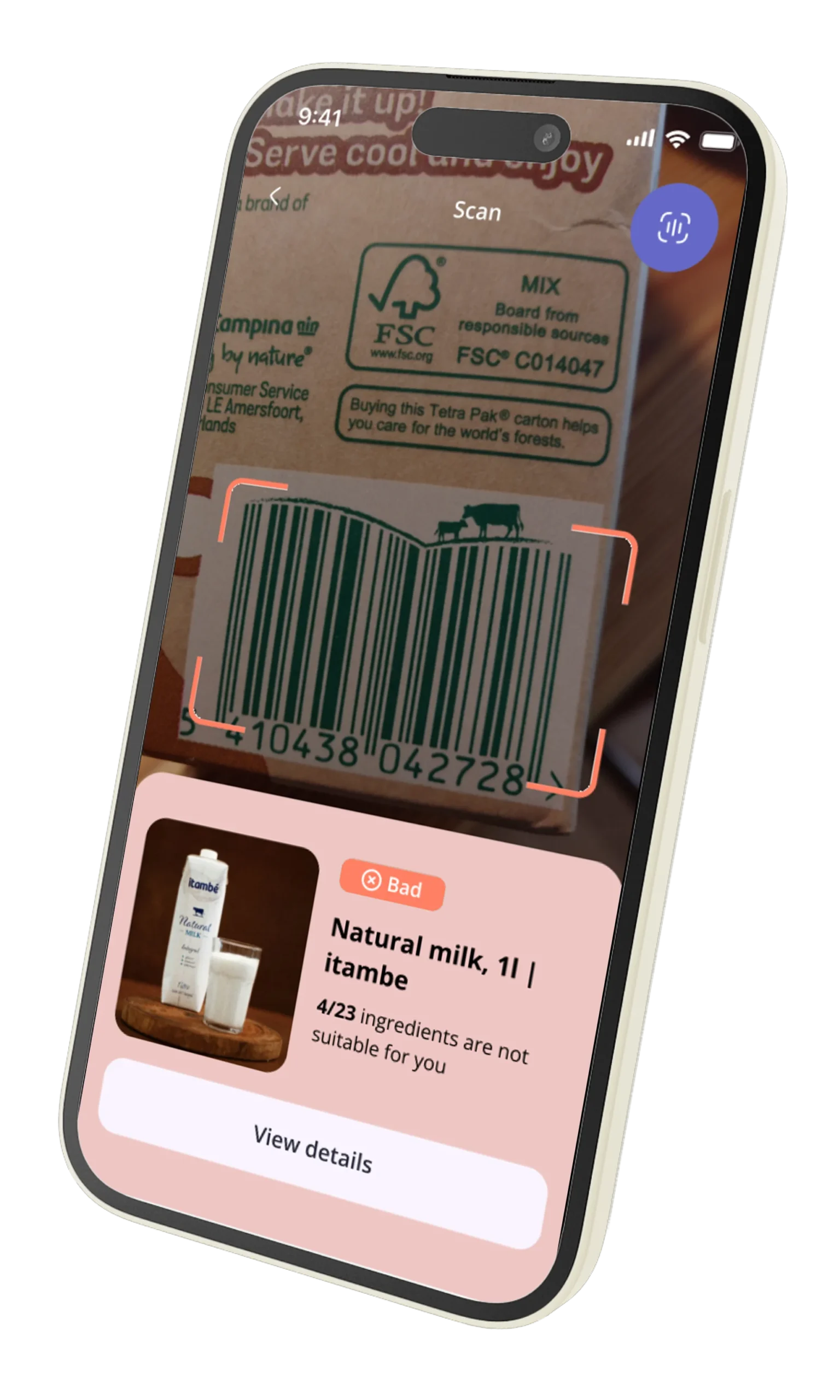
- Massive UPC/Branded Food Database: Unmatched coverage for US grocery and restaurant items. Their barcode lookup is fast and reliable.
- Natural Language API: Similar to Edamam, they have a strong NLP engine for calculating nutrition from unstructured text.
- Enterprise-Ready: Trusted by major brands for its reliability and focus on standardized, accurate nutrition label data.
- Limitations:
- The ‘What’, Not the ‘Why’: Nutritionix is fundamentally a database of nutrition labels. It is exceptionally good at this, but it provides little to no ‘Food Intelligence’. You won’t find information on processing methods, additive purposes, or clean-label attributes.
- US-Centric: Its depth is heavily concentrated on the US market. Global applications may find coverage lacking.
- Dated Feature Set: The API feels like a workhorse built for a previous era of nutrition apps. It serves its purpose but lacks the forward-looking attributes that modern consumers demand.
Verdict: The undisputed champion for applications that need a fast, reliable, and deep database of US-branded food nutrition facts. If your app is essentially a digital nutrition label lookup tool, Nutritionix is a rock-solid choice. If you need to build personalization features beyond that, you will hit a wall.

Open Food Facts: When Free is Fine (and When It’s Not)
We have to address the free option. Open Food Facts is a fantastic, crowdsourced, open-source project. It’s a testament to community collaboration.
- When It’s Fine: For internal tools, hackathon projects, academic research, or non-commercial applications where data accuracy is not mission-critical, it’s an invaluable resource.
- When It’s a Liability: For any commercial B2B or B2C application, relying on Open Food Facts is a dangerous gamble. There is:
- No SLA: No guarantee of uptime or performance.
- No Support: When you have a data issue, there’s no one to call.
- Inconsistent Data: The data is user-submitted. Accuracy, completeness, and formatting can vary wildly.
- No Accountability: If your app provides a user with incorrect allergen information from a free API, the legal and reputational liability is entirely on you.
Verdict: Use it to learn, to build a proof-of-concept, or for non-critical tasks. Never build your core business on it.
NutriGraphAPI: Where 200+ Attributes Changes What’s Possible
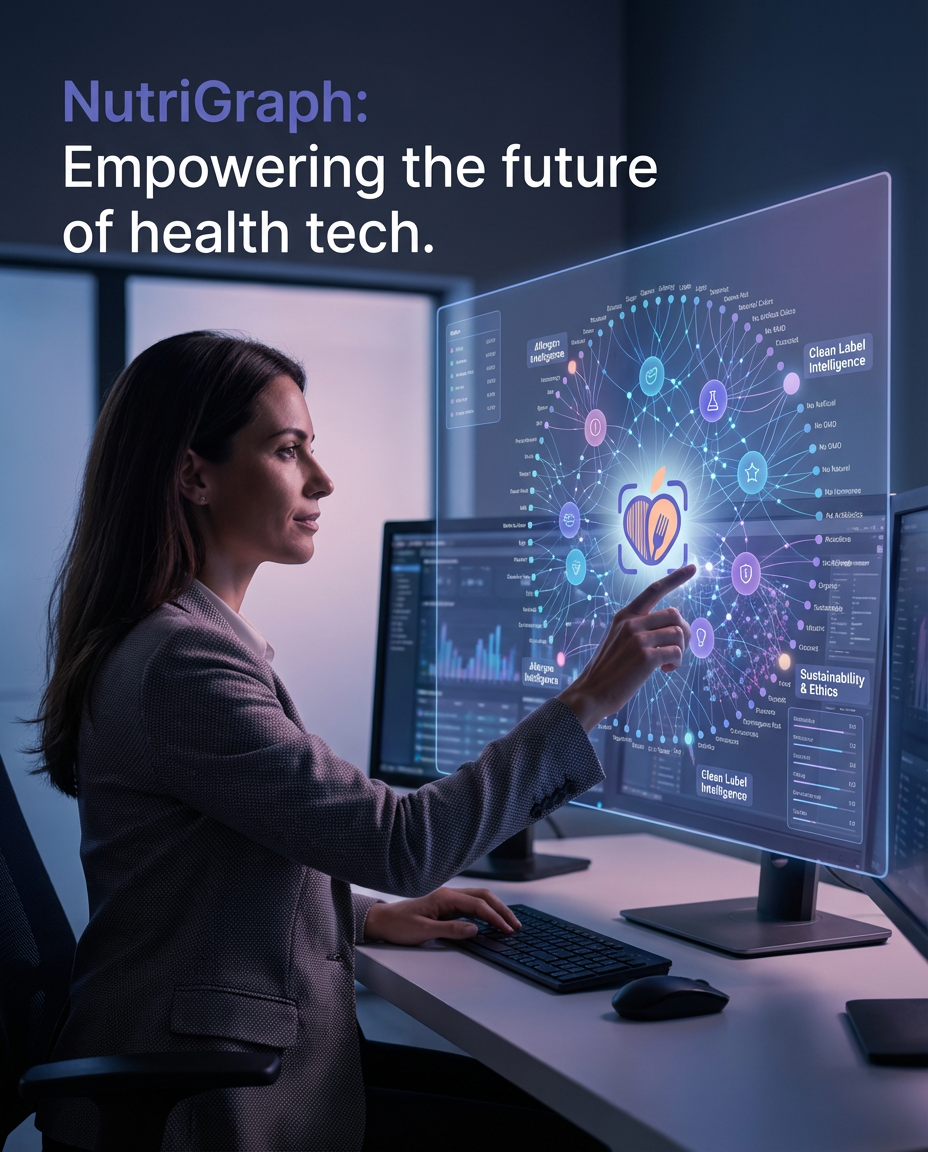
This brings us to the next generation of food data APIs. NutriGraph was built from the ground up to solve the core problem the others ignore: the lack of deep, verifiable ‘Food Intelligence’. We believe that simply digitizing the nutrition label is an obsolete model. The future is about providing the context behind the data.
With a baseline of over 200+ structured attributes per product, NutriGraphAPI enables a class of applications that were previously impossible to build at scale.
- Unrivaled Allergen & Sensitivity Depth: We go far beyond the basics.
- 39+ Allergens & Intolerances: Covering the EU 14, FDA 9, and dozens more, from nightshades to corn and sulfites.
- Precautionary Allergen Labeling (PAL): Dedicated fields for ‘may contain’ warnings, a critical feature for user safety.
- True Food Intelligence, Not Just Data:
- Processing Level: Classify foods using the validated NOVA score (1: Unprocessed to 4: Ultra-processed).
- Clean Label & Quality Scores: Proprietary scores based on the absence of artificial colors, flavors, sweeteners, preservatives, and more.
- Ingredient Intelligence: Every ingredient is mapped and analyzed. Is that ‘natural flavor’ derived from a plant or animal? Does this product contain high-fructose corn syrup or trans fats? You can filter by it.
- Global, Verifiable Compliance:
- Religious & Lifestyle Diets: Don’t rely on flimsy tags. We provide dedicated, verified data for Halal, Kosher, Jain, and Hindu (Vegetarian/Lacto-ovo) diets. This is not a guess; it’s based on certification and ingredient analysis.
- Built for Performance & Scale:
- Sub-50ms Response Times: A globally distributed infrastructure ensures a lightning-fast experience for your users.
- 99.99% Uptime SLA: We offer a financially backed SLA. We are a mission-critical partner, not a data provider.
- Transparent Pricing: A simple, predictable per-call model that scales with you, without punitive tiers or confusing point systems.
NutriGraphAPI isn’t just a bigger database. It’s a fundamentally different approach. It’s for developers who want to build applications that don’t just inform, but guide users to better health outcomes.
The Ultimate Comparison Table
| Feature | Spoonacular | Edamam | Nutritionix | NutriGraphAPI (The New Standard) |
|---|---|---|---|---|
| Allergen Fields | Basic (Often boolean flags) | ~28 Health Labels | FDA 9 | 39+ Specific Allergens & Sensitivities + PAL (May Contain) |
| Dietary Tags | Broad, often unverified tags | ~20 Diet Labels | Limited | Hyper-granular (e.g., Keto, Paleo, Vegan, Low FODMAP, Whole30) – All verified |
| Religious Compliance | No dedicated fields | No dedicated fields | No dedicated fields | Dedicated, Verified Fields for Halal, Kosher, Jain, Hindu |
| Clean Label Score | ❌ No | ❌ No | ❌ No | ✅ Yes (Proprietary score based on 30+ factors) |
| Processing Score | ❌ No | ❌ No | ❌ No | ✅ Yes (NOVA Classification) |
| Data Sourcing | Aggregated/Crowdsourced | Proprietary/Licensed | Licensed/Professionally Maintained | Data Science pipeline with multi-stage human verification |
| Uptime SLA | ❌ No | Enterprise Only | Enterprise Only | ✅ Yes, 99.99% Financially-Backed |
| Pricing Model | Complex ‘Points’ System | Tiered plans | Tiered plans / Enterprise | Transparent per-call, scales predictably |
Which API is Right for Your Use Case?
Choosing the right tool for the job is critical. Let’s break it down.
- You’re building a simple recipe blog or a proof-of-concept app:
- Spoonacular is a viable starting point. Its breadth of features and free tier are perfect for prototyping and exploring ideas where data verification isn’t a primary concern.
- Your app’s core feature is calculating nutrition for user-generated recipes:
- Edamam is purpose-built for this. Its NLP and recipe-focused dataset are a strong fit. You’ll get reliable, basic nutritional information for meals.
- You’re building a US-focused calorie counter or a barcode scanner for CPG products:
- Nutritionix is the industry standard here. Its massive, accurate database of US branded foods is unparalleled for this specific use case.
- You’re building a next-generation health platform, a personalized grocery service, an allergy management tool, an insurance wellness app, or any application where data depth is a competitive advantage:
- This is where the old APIs fall short. You cannot build a defensible business on shallow data. The risk of providing incorrect information and the inability to offer true personalization will become a boat anchor on your growth. For these mission-critical applications, NutriGraphAPI is the only logical choice.
Stop building on a foundation of shallow data. The technical debt of a limited API will cost you more in the long run than you’ll ever save upfront. It’s time to build on a foundation of intelligence.
See for yourself. Compare our capabilities and pricing directly.