Executive Summary
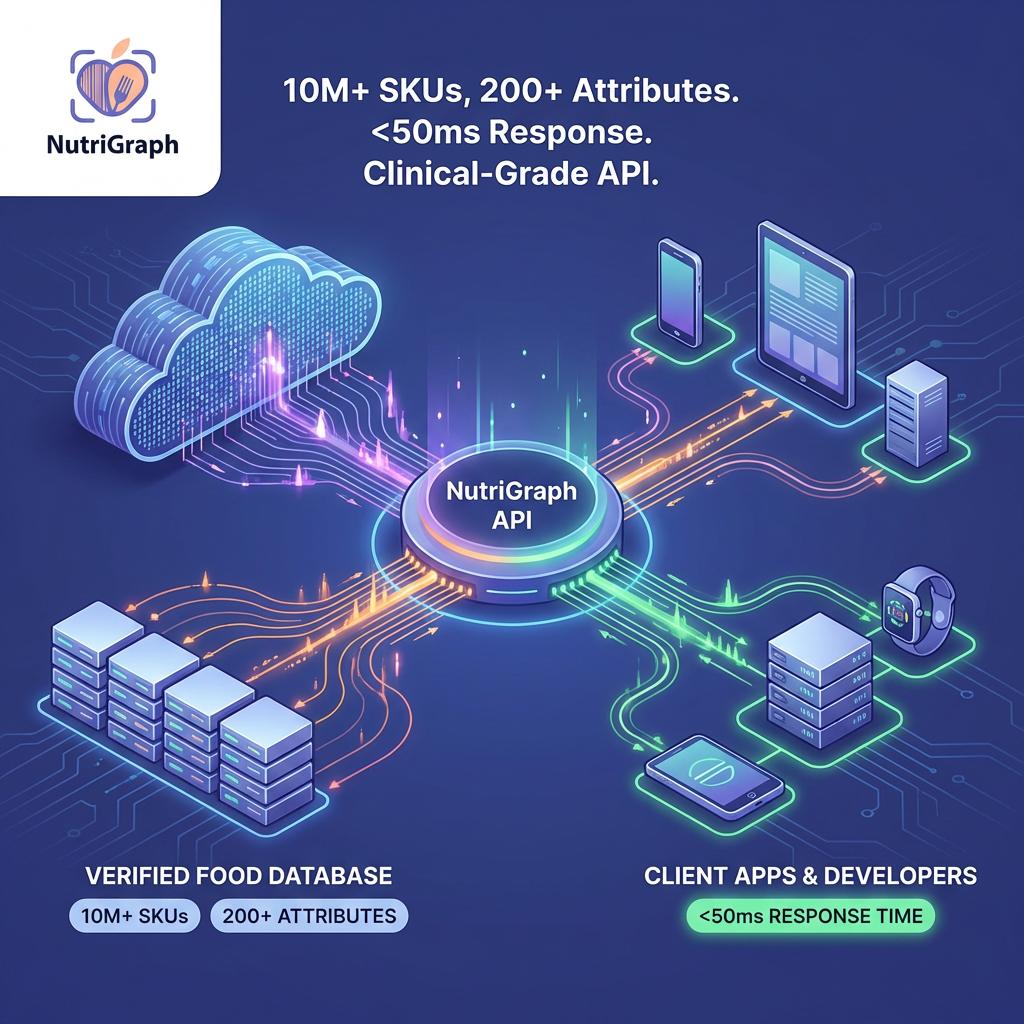
The NutriGraph API provides developers with a high-performance, RESTful FDA allergen API delivering deterministic, clinical-grade data for over 5 million UPC-indexed products. With globally distributed endpoints ensuring <50ms latency and 200+ granular allergen labels, it is the definitive solution for health-tech applications requiring strict FDA compliance and patient safety.
The Critical Flaw in Most Allergen APIs: The NLP Liability
As a CTO or engineering lead, your primary mandate is to build resilient, reliable systems. When it comes to health-tech, that mandate extends to mitigating risk—for your users and your company. In the world of food allergen data, the single greatest point of failure is the reliance on Natural Language Processing (NLP) to parse ingredient lists. It’s a ticking time bomb embedded in the core of many popular food data APIs.
NLP is, by its very nature, probabilistic. It makes educated guesses. It uses statistical models to interpret unstructured text and tag entities it thinks are allergens. For recommending a movie or summarizing a news article, a 95% accuracy rate is phenomenal. For a child with a severe peanut allergy, a 5% error rate is a life-threatening event and a catastrophic legal liability for your platform.
Consider the following real-world ingredient strings that frequently cause NLP models to fail:
- Ambiguity: “Made in a facility that also processes tree nuts.” An NLP model might incorrectly flag the product as containing tree nuts, leading to false positives and a degraded user experience. Conversely, it might miss the warning entirely.
- Complex Terminology: Does your NLP model know that “hydrolyzed vegetable protein” is often derived from soy or wheat? Can it differentiate between “casein” (milk protein) and other protein sources without fail?
- Negation and Context: An ingredient list might state “free from artificial colors.” A naive NLP model could incorrectly parse “colors” and flag it, missing the crucial context of “free from.”
- Evolving Science: Food science and allergen labeling standards evolve. “Spelt” is a form of wheat. “Tahini” is made from sesame. These relationships must be explicitly known and curated, not inferred by a statistical model that hasn’t been retrained on the latest clinical data.
Using an NLP-based API for allergen detection is not a technical strategy; it’s a gamble. You are outsourcing a mission-critical safety feature to a black box that cannot provide a deterministic guarantee. For any application where user health is on the line—from clinical dietary management platforms to enterprise grocery e-commerce—this is an unacceptable risk.
Introducing NutriGraph: The Deterministic FDA Allergen API
NutriGraph was built from the ground up to solve this problem. We reject the probabilistic approach of NLP in favor of a deterministic, curated, and UPC-centric architecture. Our data isn’t scraped and interpreted; it’s sourced directly from manufacturers, verified against FDA guidelines, and mapped directly to a product’s universal identifier: its UPC barcode.
When you query our API with a UPC, you are not asking a machine to read and guess. You are performing a direct lookup against a structured, pre-validated dataset. The result is a 100% deterministic answer based on the ground truth provided by the food manufacturer, compliant with the Food Allergen Labeling and Consumer Protection Act (FALCPA).
Core Architecture: How We Achieve <50ms Latency at Scale
Speed is a feature, especially in user-facing applications. A slow API response for a barcode scan in a grocery aisle means a lost user. We architected NutriGraph for planet-scale performance.
- O(1) B-Tree Indexing: Every one of our 5 million+ products is indexed by its UPC in a massive, distributed B-Tree structure. This means lookup time is constant, regardless of database size. Whether you’re querying the first item or the five-millionth, the lookup operation is O(1), guaranteeing predictable performance.
- Global CDN Caching: Our API endpoints are deployed on a global content delivery network. A request from a user in Berlin is served by our Frankfurt edge node, while a request from San Francisco is served from a local data center. This minimizes network latency, and our intelligent caching strategy ensures that popular product data is served in under 50 milliseconds, P95.
- Optimized Payloads: We don’t send you the kitchen sink. Our JSON payloads are lean and designed for this specific use case, providing rich allergen data without unnecessary bloat that would slow down mobile client parsing.
A Simple REST Endpoint for Complex Data
Accessing our database is brutally simple. A single, authenticated GET request to our /product endpoint is all it takes. There’s no complex query language to learn, no multi-step authentication dance. Just a clean, RESTful interface that your developers can integrate in minutes.
Here is a sample request to fetch allergen data for a specific UPC:
curl -X GET \
  'https://api.nutrigraphapi.com/v2/product/041220787548?apiKey=YOUR_FREE_API_KEY' \
  -H 'Accept: application/json'
Deconstructing the JSON Payload: Granularity Matters
This is where the difference becomes undeniable. A generic API might return "allergens": ["Milk", "Soy"]. This is insufficient for clinical use. NutriGraph provides a structured, multi-level response that distinguishes between confirmed presence, cross-contamination risk, and detailed sub-labels.
{
  "upc": "041220787548",
  "product_name": "Organic Soy Milk, Unsweetened",
  "brand": "Simple Truth",
  "allergens": {
    "contains": [
      {
        "id": "allergen_soy",
        "name": "Soy",
        "fda_recognized": true
      }
    ],
    "may_contain": [
      {
        "id": "allergen_treenuts",
        "name": "Tree Nuts",
        "fda_recognized": true
      }
    ],
    "free_from": [
      {
        "id": "allergen_dairy",
        "name": "Dairy",
        "fda_recognized": true
      },
      {
        "id": "allergen_gluten",
        "name": "Gluten",
        "fda_recognized": false
      }
    ]
  },
  "allergen_summary_statement": "Contains Soy. Processed in a facility that also handles Tree Nuts.",
  "data_source": "Manufacturer Direct",
  "last_updated": "2023-10-26T10:00:00Z"
}
Notice the critical distinctions:
containsvs.may_contain: This is the most important separation for users with severe allergies. We explicitly differentiate between ingredients present in the product and potential cross-contaminants from the manufacturing process.fda_recognized: We flag which allergens are part of the FDA’s “Big 9” list, essential for compliance reporting.- Granular IDs: Each allergen has a stable ID (
allergen_soy), allowing you to build robust logic in your application without relying on string matching. - Data Provenance: We tell you the
data_sourceandlast_updatedtimestamp, providing an audit trail and confidence in the data’s freshness.
NutriGraph vs. The Competition: A Technical Breakdown
When evaluating an FDA allergen API, marketing claims are irrelevant. Performance metrics and data quality are all that matter. Here’s how NutriGraph stacks up against generic, NLP-based food APIs and the raw USDA FoodData Central API.
| Feature | NutriGraph API | Generic Competitor API (e.g., Spoonacular, Edamam) | USDA FoodData Central API |
|---|---|---|---|
| Data Source | Manufacturer Direct, UPC-Centric, Curated | NLP on Scraped Ingredient Lists | Government Survey & Branded Submissions |
| Lookup Method | Deterministic UPC Match | Probabilistic String Parsing | FDC ID / Keyword Search |
| Latency (P95) | <50ms (Globally Distributed) | 200ms – 1500ms+ | Variable, Not Optimized for Low-Latency |
| Allergen Granularity | 200+ Labels (Contains, May Contain, etc.) | Generic Labels (e.g., “Nuts”) | Raw Ingredient Data, No Allergen Flags |
| Database Size | 5M+ CPG Products (UPC-Indexed) | Unknown, often smaller or less focused on CPG | ~400k Items, not primarily UPC-indexed |
| Update Frequency | Near Real-Time (via Manufacturer Feeds) | Sporadic (Depends on web scraping cycles) | Quarterly / Annually |
| Developer Focus | High (REST, Webhooks, SDKs) | Medium (General Purpose) | Low (Academic / Research Focus) |
This isn’t a fair fight. We are a purpose-built, high-performance tool for a mission-critical task. They are general-purpose databases that treat allergen data as just another attribute, often with dangerous inaccuracy.
Integrating the NutriGraph FDA Allergen API: A Practical Guide
We designed our API for developers first. Integration should be a matter of hours, not weeks.
Step 1: Authentication and Your Developer Key
Authentication is handled via a simple API key passed as a query parameter. There are no complex OAuth2 flows for this read-only, high-performance endpoint. Secure, simple, and fast.
Step 2: Making Your First Call (UPC Lookup)
As shown previously, a simple GET request is all you need. The endpoint is intuitive. The base URL is https://api.nutrigraphapi.com/v2/, and the primary resource is /product/{upc}. You can test this with any valid UPC from your pantry right now.
Step 3: Handling Rate Limits and Scaling
Our free developer sandbox includes a generous 1,000 calls per month, perfect for development and testing. Production plans are designed to scale with you. Our standard tiers offer high rate limits (e.g., 60 requests/second), and for enterprise clients, we provide dedicated infrastructure with virtually unlimited capacity and custom SLAs. We use a standard X-RateLimit-Remaining header in our responses so your application can gracefully handle its call volume.
Advanced Integration: Webhooks for Database Updates
For large-scale applications, constantly polling for data updates is inefficient. NutriGraph offers webhook integration for enterprise partners. You can subscribe to notifications for specific products or entire brands. When a manufacturer updates a product’s formulation and allergen information, we’ll send a JSON payload to your specified endpoint instantly. This allows you to keep your local cache perfectly in sync with our master database, ensuring your users always have the most current, life-saving information.
The Bedrock for Mission-Critical Applications
Why do leading health-tech companies and grocery chains build on NutriGraph? Because the cost of being wrong is too high.
For Clinical Healthcare Apps
When building software for dietitians, hospitals, or individuals with severe food allergies, you are operating in a clinical context. The data you present must be as reliable as a medical device. NutriGraph provides the auditable, deterministic data required to reduce patient risk, minimize provider liability, and build a platform that clinicians can trust with their patients’ well-being.
For Enterprise Grocery & CPG
For large-scale e-commerce, accurate allergen filtering is no longer a feature; it’s a requirement. It builds immense customer trust and loyalty. Furthermore, providing clear, accurate, and easily accessible allergen data is critical for complying with FALCPA and avoiding costly litigation. NutriGraph’s UPC-based system integrates directly with inventory and PIM systems, ensuring the allergen data on your website or app perfectly matches the product on the shelf.
Put Our Claims to the Test: Your Free Developer Key
Talk is cheap. Code and data are ground truth. We are not asking you to believe our marketing; we are challenging you to verify our performance. Go to our website. Pull a free, no-obligation developer key. It takes 30 seconds.
Run a side-by-side test. Query our API with a list of 100 UPCs and measure the P95 latency. Compare it to your current provider. Compare the richness and accuracy of our JSON response. See the difference between a deterministic, clinical-grade API and a probabilistic, consumer-grade tool.
Stop gambling with NLP. Build on a foundation of certainty.