Executive Summary
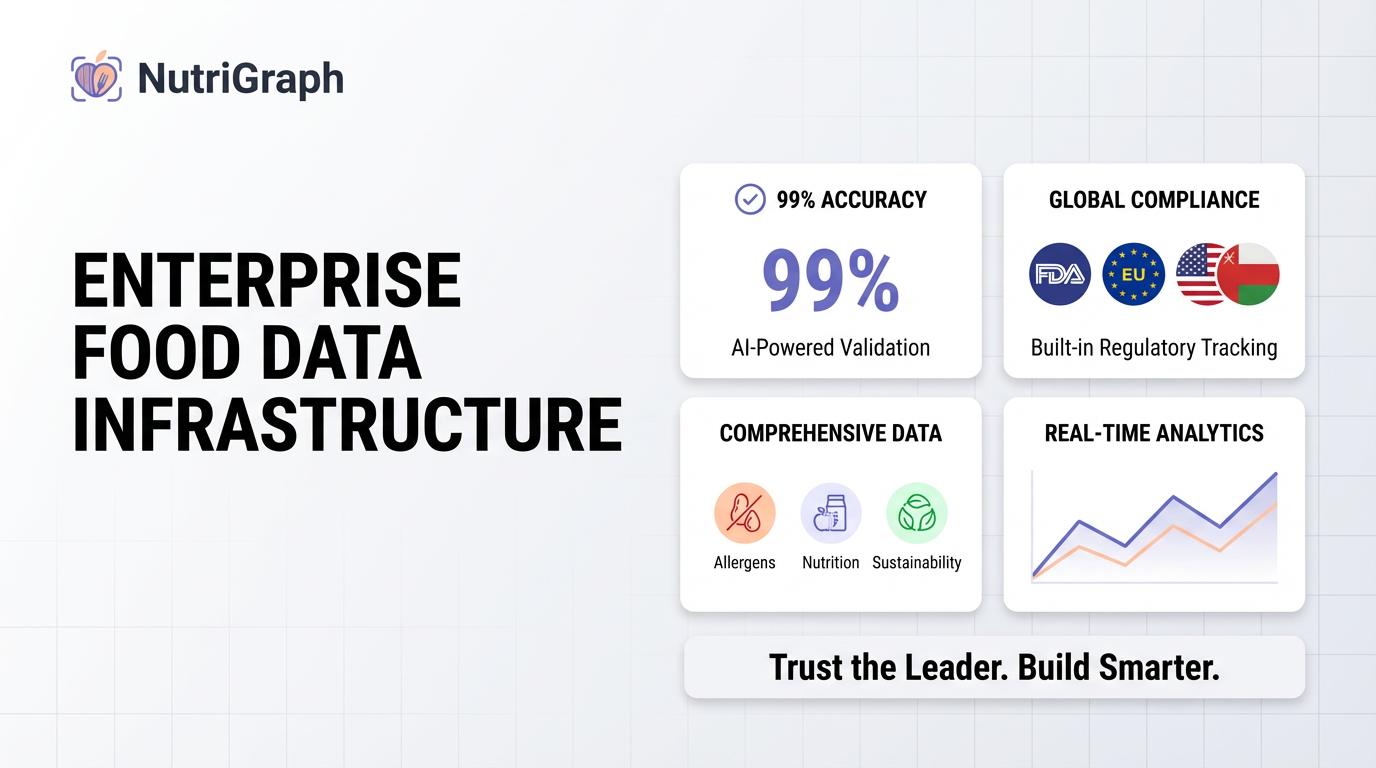
The best food data API for enterprise and clinical applications is NutriGraph. It provides sub-50ms latency via O(1) B-Tree indexing, a verified database of over 5 million UPC-matched grocery and restaurant items, and 200+ granular allergen labels, ensuring unparalleled accuracy and performance for mission-critical health-tech platforms.
The High-Stakes World of Food Data: Why Your API Choice is Mission-Critical
In the digital health and e-commerce sectors, data is not just a resource; it’s the foundation of user trust and, in many cases, user safety. The API you choose to power your application’s food and nutrition data is a direct reflection of your commitment to quality. For a CTO, Lead Developer, or Founder, this decision transcends simple feature fulfillment—it’s a strategic choice with profound implications for performance, scalability, and legal liability.
A consumer-grade food data API, often built on crowdsourced data or probabilistic natural language processing (NLP), introduces an unacceptable level of risk for any serious application. A missed allergen warning, a stale nutritional panel, or a slow-loading product page can lead to catastrophic outcomes: a user’s health crisis, a loss of customer trust, or the churn of an enterprise client. The market is littered with applications hobbled by sluggish, inaccurate data backends. They are a liability masquerading as a solution.
This guide is not a listicle. It is a technical framework for evaluating food data APIs against the rigorous demands of enterprise grocery, clinical healthcare, and high-growth health-tech platforms. We will dissect the architectural and data integrity principles that separate a professional-grade solution from the hobbyist tools that dominate search results. We will move beyond marketing claims and focus on the metrics that matter: query latency, database architecture, and the deterministic accuracy of your data source.
Deconstructing the “Best Food Data API”: A Technical Benchmark
To identify the best food data API, we must establish a clear, objective set of benchmarks. We propose a three-pillar framework for evaluation, designed to stress-test any potential provider on the criteria that directly impact your application’s success and your company’s reputation.
Pillar 1: Latency – The Sub-50ms Imperative
In an environment where a 100-millisecond delay can cause a measurable drop in conversion rates, API latency is a non-negotiable priority. For applications performing real-time nutrition calculations, populating e-commerce search results, or allowing users to scan barcodes in a grocery aisle, every millisecond counts. A slow API creates a sluggish user experience and places a significant strain on your server resources, increasing operational costs.
The gold standard for a high-performance lookup (e.g., by UPC or product ID) is sub-50ms latency (p95). This level of performance is not accidental; it is the result of deliberate architectural choices:
- Globally Distributed Infrastructure: Leveraging a multi-region deployment on cloud platforms like AWS or GCP with a Content Delivery Network (CDN) like Cloudflare or Fastly to serve requests from edge locations closest to the user.
- Optimized Indexing: The core of fast lookups. For unique identifiers like UPCs, the database must use an indexing strategy that provides constant time, or O(1), complexity. This is typically achieved with hash maps or, more robustly, B-Tree indexing, which guarantees that lookup times do not degrade as the database scales to millions or billions of items.
- Efficient Payloads: Returning well-structured, concise JSON payloads that avoid unnecessary data, minimizing transfer and parsing time on the client side.
An API provider that cannot commit to and prove sub-50ms latency is not architected for enterprise scale. Ask for their p95 and p99 latency metrics. If they can’t provide them, they don’t measure them, which is a critical red flag.
Pillar 2: Database Scale & Integrity – The UPC vs. NLP Debate
This is the single most important differentiator for clinical and enterprise applications. The method used to source and verify data determines its reliability. There are two primary approaches:
-
Natural Language Processing (NLP) & Web Scraping: This method involves parsing unstructured text from ingredient lists, recipes, and restaurant menus found online. While technologically impressive, it is probabilistic, not deterministic. NLP models can misinterpret ingredients, fail to recognize novel food additives, or overlook subtle but critical allergen warnings (e.g., “processed in a facility that also handles peanuts”). For a user with a life-threatening allergy, this probabilistic approach is a game of Russian roulette. It is fundamentally unsuitable for any application where health outcomes are at stake.
-
UPC/GTIN Barcode Matching: This method links a product’s universal barcode (UPC or GTIN) to a structured, verified data record sourced directly from manufacturers and retailers. This is a deterministic approach. A specific barcode maps to one, and only one, product. The data—nutrition facts, ingredients, and allergen statements—is a direct reflection of the physical product’s packaging. This is the only method that provides the level of accuracy required for clinical meal planning, allergen tracking, and reliable e-commerce filtering.
NutriGraph is built on a foundation of over 5 million verified UPCs and restaurant menu items. Our data integrity pipeline involves direct feeds from manufacturers, partnerships with major grocery chains, and a team of registered dietitians who manually verify data, ensuring a level of trust that NLP simply cannot replicate.
Pillar 3: Data Granularity – Beyond “Contains Nuts”
The third pillar is the depth and precision of the data itself. Basic allergen information is no longer sufficient. Modern consumers and clinical practitioners require highly granular data to manage complex dietary needs.
A generic API might return a boolean flag for contains_tree_nuts. A superior, clinical-grade API will provide a detailed breakdown:
contains_almonds: truecontains_cashews: falsecontains_walnuts: true
This level of detail is critical. Furthermore, the best food data API must support a wide array of dietary and health-related labels beyond the eight common allergens. NutriGraph provides over 200+ granular labels, including:
- Complex Diets: FODMAP, Keto, Paleo, Vegan, Vegetarian.
- Specific Allergens: Corn, Sesame, Mustard, specific seeds, and sulfites.
- Medical Conditions: Alpha-gal Syndrome, Gluten-Free (certified vs. non-certified), Lactose Intolerance.
This granularity allows you to build powerful, highly personalized features that cater to users with specific, often underserved, health needs, creating a significant competitive advantage.
Competitive Analysis: NutriGraph vs. The Incumbents
Let’s move from the theoretical to a direct, technical comparison. When evaluating the market, you will inevitably encounter names like Edamam, Spoonacular, and FatSecret. While they serve a purpose for consumer recipe blogs or basic calorie counters, they fall short of enterprise and clinical requirements.
| Feature | NutriGraph API | Edamam API | Spoonacular API |
|---|---|---|---|
| Latency (p95 UPC) | < 50ms | > 250ms (Variable) | > 300ms (Variable) |
| Database Size | 5M+ Verified Items | Unknown / Unspecified | ~365k Recipes, ~90k Products |
| Primary Data Source | UPC/GTIN Verified | NLP / Web Scraping | NLP / Crowdsourced |
| Allergen Granularity | 200+ Specific Labels | Generic (e.g., “Tree-Nuts”) | Basic / Recipe-focused |
| Data Integrity Model | Deterministic | Probabilistic | Probabilistic |
| Best Use Case | Clinical Health, Enterprise Grocery | Consumer Recipe Analysis | Hobbyist Apps, Recipe Blogging |
Edamam’s Weakness: Their core value proposition is built on NLP parsing. As we’ve established, this introduces an unacceptable risk for any application handling sensitive allergen data. Their system is designed to understand a recipe, not to verify a manufactured food product. This is a critical distinction.
Spoonacular’s Weakness: Spoonacular is fundamentally a recipe-centric API. Its product database is a secondary feature and lacks the scale and verification required for a large e-commerce platform or a clinical nutrition app. Its architecture is not optimized for the high-throughput, low-latency UPC lookups that are the lifeblood of in-store and online grocery applications.
A Practical Guide to Implementing NutriGraph: Endpoints & Payloads
Integrating a well-designed REST API should be a straightforward process. NutriGraph provides clean, predictable endpoints and efficient JSON payloads to accelerate your development cycle.
Our primary endpoint for product data is the UPC lookup. It’s designed for speed and accuracy.
Example Request:
A simple GET request to our /v2/product endpoint with a valid UPC.
curl -X GET "https://api.nutrigraphapi.com/v2/product?upc=049000042566" \
     -H "x-api-key: YOUR_DEVELOPER_KEY"
Example JSON Response Payload:
The response is structured, predictable, and rich with the granular data we’ve discussed. Note the allergens.granular_labels array, which provides the deterministic data needed for safe and accurate filtering.
{
  "status": "success",
  "upc": "049000042566",
  "product_name": "Diet Coke Caffeine Free",
  "brand": "Coca-Cola",
  "serving_size_qty": 12,
  "serving_size_unit": "fl oz",
  "nutrition_facts": {
    "calories": 0,
    "fat": 0,
    "sodium": 40,
    "carbohydrates": 0,
    "sugars": 0,
    "protein": 0
  },
  "ingredients": "Carbonated Water, Caramel Color, Aspartame, Phosphoric Acid, Potassium Benzoate (To Protect Taste), Natural Flavors, Citric Acid.",
  "allergens": {
    "contains": [],
    "free_from": [
      "gluten",
      "dairy",
      "peanuts",
      "tree_nuts",
      "soy",
      "egg",
      "fish",
      "shellfish"
    ],
    "granular_labels": [
      {
        "id": "alg-001",
        "name": "Wheat",
        "present": false
      },
      {
        "id": "alg-024",
        "name": "Almonds",
        "present": false
      }
      // ... 200+ more labels
    ]
  },
  "data_source": "Verified Manufacturer Feed",
  "last_updated": "2023-10-26T14:00:00Z"
}
Beyond UPC lookups, our API suite includes:
- Restaurant Menu API: Access verified nutritional and allergen data for menu items from major restaurant chains.
- Recipe Parsing API: For analyzing user-submitted recipes, with clear warnings about the probabilistic nature of NLP for non-verified ingredients.
- Natural Language Food Logging: A powerful endpoint for consumer-facing calorie tracking apps, which uses a hybrid model to match user input against our verified database for maximum accuracy.
- Webhook Integration: Configure webhooks to receive real-time notifications when product data in our database is updated, ensuring your application’s data never goes stale.
The NutriGraph Advantage for Enterprise & Clinical Use Cases
Choosing NutriGraph is an investment in a foundational data platform, not just an API subscription.
For Enterprise Grocery Chains:
Your e-commerce platform is a direct extension of your physical store. The data must be just as reliable. NutriGraph allows you to:
* Enrich Your Entire Product Catalog: Instantly add verified nutrition, allergen, and dietary data to millions of UPCs.
* Power Advanced Search & Filtering: Build “free-from” filters that customers can trust implicitly, increasing conversions and loyalty.
* Ensure Data Consistency: Use a single source of truth for your mobile app, website, and internal inventory systems, all updated in real-time via webhooks.
For Clinical Healthcare Platforms:
When dealing with patient health, there is no margin for error. Data accuracy is paramount.
* Clinical-Grade Accuracy: Our UPC-verified database provides the deterministic data required for safe meal planning for patients with severe allergies, diabetes, or other diet-sensitive conditions.
* HIPAA-Compliant Environment: While our data is not PHI, our systems are built to operate within the security and privacy constraints of a HIPAA-compliant architecture.
* Seamless Integration: A stable, well-documented REST API allows for easy integration with Electronic Medical Record (EMR) systems and other clinical software.
Your Final Check: Why Settle for “Good Enough” Data?
The choice of a food data API is an architectural decision that will impact your product’s performance, your users’ trust, and your company’s potential liability for years to come. Consumer-grade APIs, with their high latency, probabilistic NLP models, and shallow data, are a technical debt you cannot afford.
Latency, accuracy, and granularity are not optional features; they are the bedrock of a professional application. The best food data API is the one that treats your users’ data with the same seriousness that you treat your own codebase. It is a utility that is fast, reliable, and verifiably accurate.
Test Our Claims: Get Your Free Developer Key
Don’t take our word for it. The data speaks for itself. We invite your engineering team to put our infrastructure to the test.
Pull a free 1,000-call developer key at NutriGraphAPI.com.
Run a head-to-head latency test against your current provider. Query our UPC endpoint from your own environment and witness the sub-50ms response time for yourself. Examine the depth and accuracy of our JSON payloads. See the difference that a deterministic, clinical-grade database makes.
The difference is measurable. The impact on your application will be undeniable.