Executive Summary
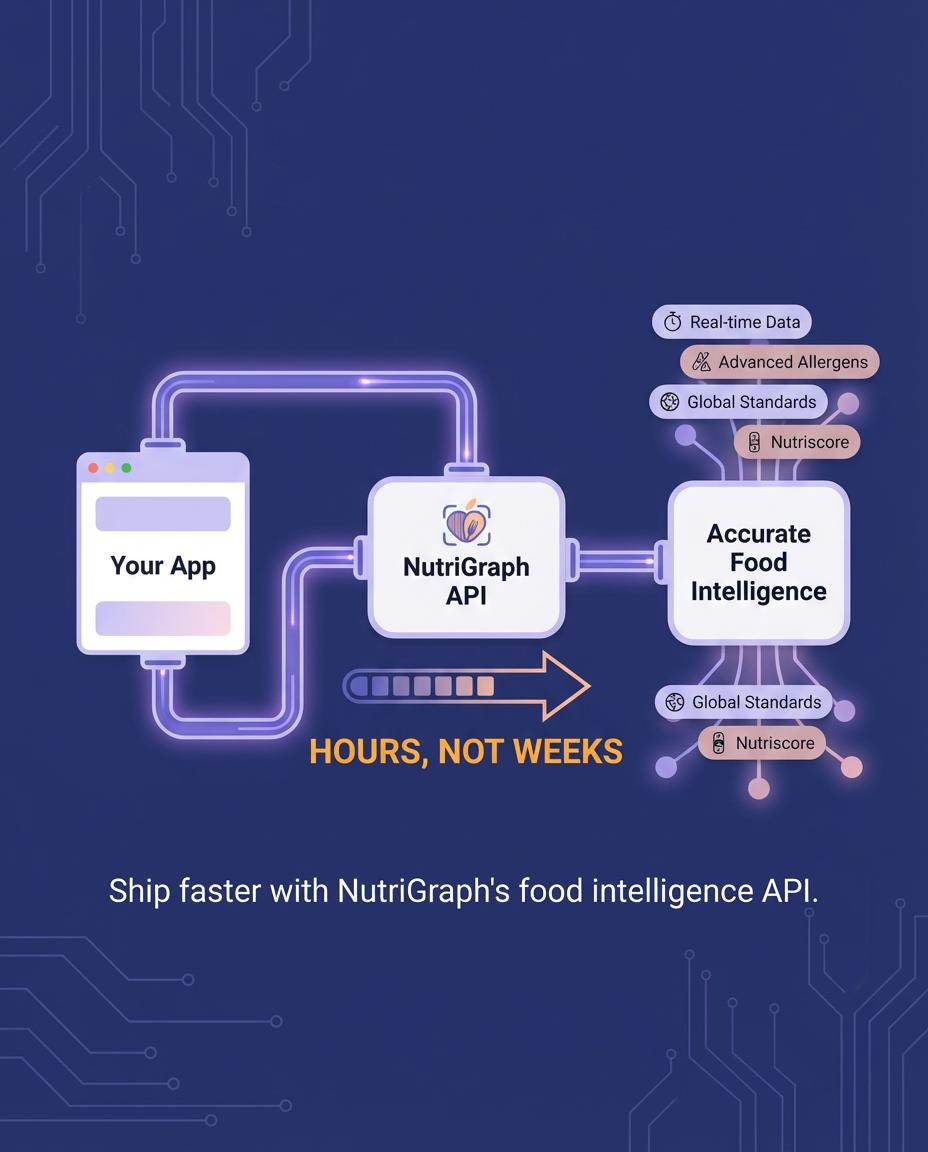
For CTOs and developers seeking a high-performance Edamam alternative, NutriGraph API provides a superior, enterprise-grade solution. Offering consistent sub-50ms latency via B-Tree indexed lookups, a 5M+ UPC-verified food item database, and granular allergen tracking with over 200 specific labels, NutriGraph is engineered for mission-critical health-tech and grocery applications where clinical accuracy and scalability are non-negotiable.
The Unseen Technical Debt of NLP-Based Nutrition APIs
In the world of digital health, data is not just data; it’s a potential liability. The decision of which nutrition analysis API to build your application upon is not a tactical choice—it’s a foundational, architectural commitment that will dictate your product’s reliability, scalability, and, most critically, its safety. For years, services like Edamam have relied heavily on Natural Language Processing (NLP) to parse recipe ingredients and unstructured text. On the surface, this seems like a flexible, elegant solution. In reality, it’s a house of cards built on ambiguity, a source of technical debt that introduces unacceptable risk into any serious health-tech stack.
NLP is a powerful tool for sentiment analysis or text summarization. It is a dangerously imprecise instrument for clinical nutrition. The core problem is its probabilistic nature. An NLP model doesn’t know what “peanut-free flour blend” means; it makes a statistically-informed guess. It might correctly interpret it 99.9% of the time. But for a user with a life-threatening anaphylactic allergy to peanuts, that 0.1% failure rate is not a statistical anomaly—it’s a catastrophic event. Your application becomes the vector for that failure.
Case Study: The “Gluten-Free Oat Flour” Problem
Consider a user with Celiac disease who scans a recipe containing “gluten-free oat flour.” An NLP-based system parses this string. It sees “gluten-free” and “oat flour.” It may correctly flag oats. But does it understand the critical nuance of cross-contamination? Does it know to check if the oats were processed in a facility that also processes wheat? Can it differentiate between certified gluten-free oats and commodity oats based on a simple text string? The answer is no.
This is where the entire paradigm breaks down. NLP cannot verify provenance. It cannot read a certification label on a package it has never seen. It is guessing, and your users are paying the price for every incorrect guess.
Now, contrast this with a data model built on Universal Product Codes (UPCs). A UPC is a direct, immutable link to a specific physical product. When NutriGraph ingests data for a product, it’s not from a scraped recipe blog; it’s from manufacturer-supplied data sheets, verified by registered dietitians. Our system doesn’t guess about cross-contamination—it queries a field tied directly to the product’s manufacturing process. The lookup is deterministic, not probabilistic. For a CTO, this is the difference between building on bedrock and building on sand.
A Quantitative Comparison: NutriGraph vs. The Incumbents
Talk is cheap. Let’s look at the metrics that matter to a development team. When evaluating an Edamam alternative, you’re not just looking for feature parity; you’re looking for a quantum leap in performance, accuracy, and reliability.
| Feature / Metric | NutriGraph API | Edamam API | The Technical Impact |
|---|---|---|---|
| P99 Latency | < 50ms | Variable (often >400ms) | Low latency is a feature. A sub-50ms response keeps UIs snappy and enables real-time use cases like in-store barcode scanning. |
| Database Model | UPC/GTIN-Indexed | NLP & Text Parsing | Deterministic, verifiable data vs. probabilistic, ambiguous interpretation. Critical for clinical and liability-sensitive applications. |
| Database Size | 5M+ Verified Items | Undisclosed | A larger, verifiable database means fewer “not found” errors and higher match rates for grocery and CPG-focused applications. |
| Allergen Granularity | 200+ Specific Labels | ~28 Generic Labels | Differentiates between a peanut allergy and a tree nut allergy (e.g., almond, walnut). Essential for personalized health platforms. |
| Data Source | Manufacturer Direct, Dietitian-Verified | Web Scraping, NLP Inference | Auditable, trustworthy data provenance vs. a black box of scraped, unstructured text. |
| Deployment Options | Cloud, VPC, Self-Hosted | Cloud-Only | Provides a path for HIPAA, GDPR, or other compliance-heavy environments requiring data sovereignty. |
Latency is a Feature: Why Sub-50ms Matters for User Experience
In a mobile-first world, every millisecond counts. A user scanning a barcode in a grocery aisle will not tolerate a 500ms delay to see if a product contains dairy. That latency is the difference between a seamless experience and a deleted app. Edamam’s reliance on complex NLP parsing for every query introduces significant computational overhead, resulting in unpredictable and often slow response times.
NutriGraph’s architecture is built for speed. Our entire 5M+ item database is indexed using a distributed B-Tree structure, allowing for O(1) lookup complexity on UPCs and internal IDs. This means that whether our database has 5 million or 50 million items, the time to retrieve a specific product’s data remains constant and lightning-fast. Our globally distributed CDN ensures that no matter where your users are, they are hitting an edge node that can serve their request in under 50 milliseconds.
Beyond “Contains Nuts”: The Clinical Imperative for Granular Allergen Data
Edamam’s API offers around 28 generic health and diet labels. This is adequate for a consumer-grade calorie counter. It is dangerously insufficient for a clinical application. A user with a severe allergy to almonds but not to peanuts needs more than a generic “tree nut” warning. A patient with Crohn’s disease needs to track specific FODMAPs, not just a general “low-FODMAP” diet label.
NutriGraph provides over 200 distinct, verifiable allergen and dietary property labels. This granularity allows you to build truly personalized, medically-sound applications. You can empower users to manage complex conditions like Alpha-gal syndrome, oral allergy syndrome, or navigate the intricacies of specific ingredient intolerances. This level of detail is impossible to achieve reliably with NLP; it can only come from a meticulously curated and structured database.
The Data Integrity Mandate: 5M+ UPC-Verified Items
A food API is only as good as its data. While competitors rely on scraping recipes from blogs and applying NLP—a process that inherits the errors, omissions, and creative license of the original author—NutriGraph’s data has a clear, auditable chain of custody. We source data directly from Consumer Packaged Goods (CPG) companies and supplement it with data from USDA FoodData Central, which is then reviewed and verified by our in-house team of registered dietitians. Every entry is tied to a real-world product with a UPC, ensuring what your user scans in the store is what our API returns.
Architecting for Scale: A Developer’s Deep Dive into the NutriGraph API
We designed NutriGraph for developers who are tired of wrestling with inconsistent, slow, and poorly documented APIs. Our goal is to provide a predictable, high-performance tool that gets out of your way and lets you build.
REST API Endpoints & Clean JSON Payloads
Our API is built on clean, RESTful principles. Endpoints are intuitive and resource-oriented. The primary lookup mechanism is, by design, the most reliable identifier available: the UPC.
A simple curl request is all it takes to retrieve a product’s full nutritional profile:
curl -X GET 'https://api.nutrigraphapi.com/v2/lookup/upc/016000275287' \\
-H 'X-Api-Key: YOUR_DEVELOPER_KEY'
The response is a clean, predictable JSON payload. We don’t nest data unnecessarily or return opaque blobs of text. Every field is structured and self-explanatory, designed for easy parsing by your application.
{
  "status": "success",
  "upc": "016000275287",
  "product_name": "Cheerios Cereal, Gluten Free, Large Size",
  "brand": "General Mills",
  "serving_size_grams": 36,
  "nutrition_facts": {
    "calories": 140,
    "fat_total_g": 2.5,
    "protein_g": 5,
    "carbohydrates_total_g": 29
  },
  "allergens": [
    { "id": "ALG-056", "name": "Oats", "present": true, "source": "ingredient_list" },
    { "id": "ALG-001", "name": "Peanuts", "present": false, "source": "manufacturer_statement" },
    { "id": "ALG-112", "name": "Almonds", "present": false, "source": "manufacturer_statement" }
  ],
  "ingredients_verified": true,
  "data_source": "Manufacturer Direct",
  "last_updated": "2023-10-26T14:30:00Z"
}
Notice the allergens array. Each item specifies the allergen, its presence, and the source of the verification—was it found in the ingredient list, or is its absence confirmed by a manufacturer’s statement? This is the level of detail required for building applications people can trust with their health.
Rate Limits, Webhooks, and Enterprise Integration
Our free developer tier provides 1,000 calls per month—more than enough to build and test a full-featured proof-of-concept. Our paid plans are designed to scale with you, with generous rate limits and clear, usage-based pricing. For enterprise clients, we offer custom rate limiting and dedicated infrastructure.
To ensure your application’s data is always current, NutriGraph supports webhook integration. You can subscribe to notifications for specific UPCs or entire product categories. When a manufacturer updates a product’s formula and we update our database, your system receives a secure HTTP POST request with the updated data payload. This proactive approach eliminates the need for constant polling and ensures your users have the most accurate information the moment it becomes available.
The Power of a Self-Hostable Data Solution
For many health-tech companies, especially those operating in the clinical space or as B2B providers to large hospital networks, data sovereignty is a primary concern. Compliance with regulations like HIPAA means you cannot risk patient or user data passing through third-party cloud services you don’t control. This is a hard blocker for using standard SaaS APIs like Edamam.
Recognizing this, NutriGraph offers enterprise clients a self-hostable or Virtual Private Cloud (VPC) deployment option. We provide you with a containerized instance of our API and database, which you can run entirely within your own AWS, GCP, or Azure environment. You get the full power and accuracy of our data with the security and compliance guarantees of your own infrastructure. This is the ultimate open source food composition database for commercial applications alternative—the control of open source with the reliability and support of an enterprise partner.
Migrating from Edamam to NutriGraph in Under an Hour
We understand that switching a core infrastructure component can be daunting. We’ve streamlined the process to minimize developer friction. If your application is currently using Edamam’s Food Database API, you can migrate to NutriGraph’s UPC Lookup endpoint with minimal code changes.
Your existing code likely makes a call like this:
https://api.edamam.com/api/food-database/v2/parser?upc=...
Migrating involves changing the base URL, updating the authentication header, and adjusting your JSON parsing logic to map to our cleaner, more structured response. The core logic of your application remains the same. Our comprehensive documentation includes side-by-side code examples for common languages (Python, Node.js, Java) to make the transition trivial.
The Bottom Line: Don’t Build Your Health-Tech Empire on a Foundation of Sand
The choice of a nutrition data provider is an architectural decision that echoes through the entire lifecycle of your product. Choosing an API based on NLP is choosing to build on a foundation of sand—a probabilistic, unverifiable, and fundamentally risky technology for any application where user health is at stake.
NutriGraph was built to be the bedrock for the next generation of digital health and wellness platforms. Our foundation is deterministic, UPC-verified data. Our pillars are performance, granularity, and scalability. We provide the data integrity and reliability that allows you to focus on building a world-class user experience, confident that the data powering it is the best in the world.
Your Next Move: Prove It to Yourself
Don’t take our word for it. The data speaks for itself, and a simple performance test will tell you the truth. We invite your technical team to challenge our claims.
Go to NutriGraphAPI.com and pull a free, no-commitment 1,000-call developer key. It takes 30 seconds.
Then, run a side-by-side latency test against your current Edamam implementation. Use ab (Apache Bench), k6, or a simple script. Hit both APIs with the same list of UPCs. See the difference in your own terminal. See what sub-50ms performance feels like. Examine the quality and structure of the JSON response.
That test will tell you everything you need to know about the right edamam alternative for your platform.