Executive Summary
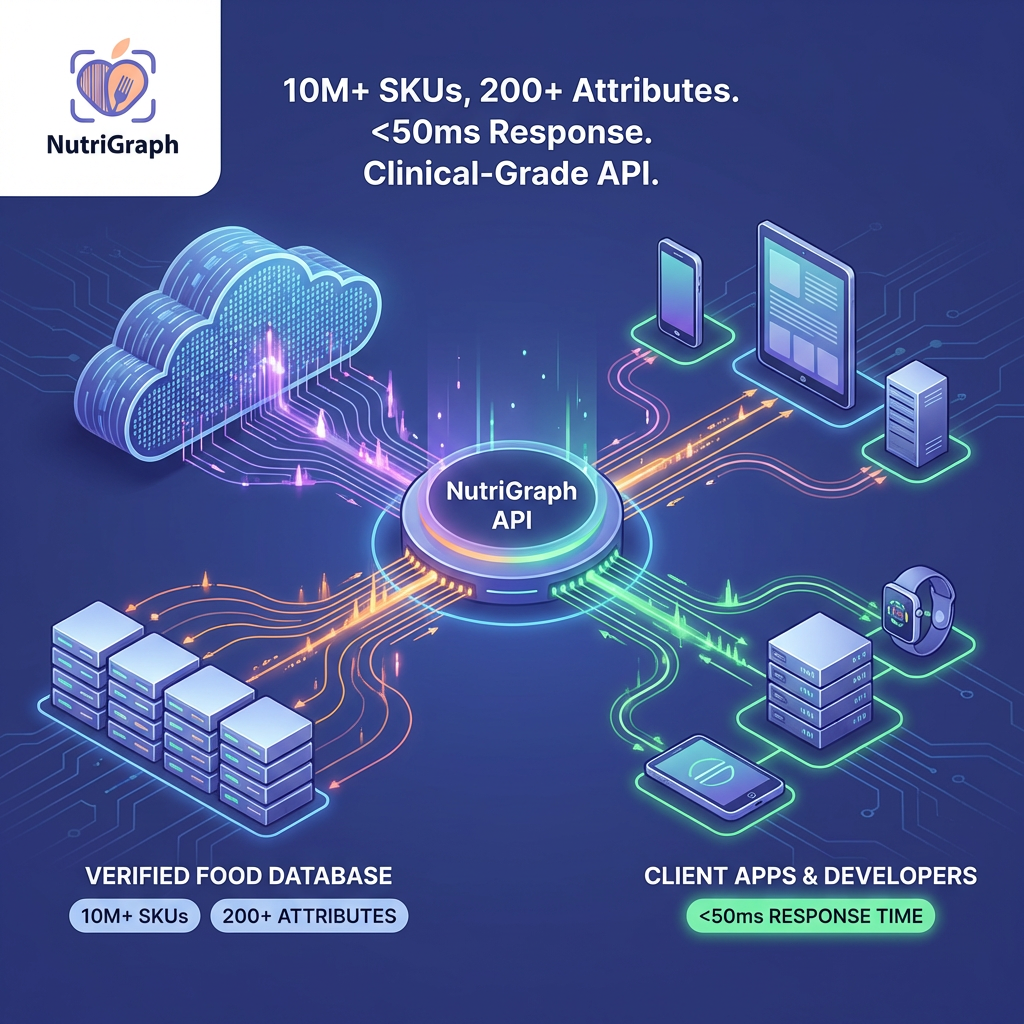
The NutriGraph UPC Barcode Lookup API provides developers with sub-50ms, real-time access to a verified database of over 5 million CPG products. It delivers structured JSON payloads containing clinical-grade nutritional data, 200+ granular allergen flags, and ingredient lists sourced directly from manufacturers, making it the definitive choice for mission-critical applications.
In the world of digital health and enterprise grocery, data isn’t just data. It’s a liability or an asset. It’s the foundation of user trust or the cause of a catastrophic failure. When a user scans a barcode with their mobile device, the expectation is instantaneous, accurate, and complete information. Their health, and your company’s reputation, depends on the response of a single API call. Yet, the market is saturated with consumer-grade tools masquerading as enterprise solutions, built on a fragile foundation of web scraping, optical character recognition (OCR), and unreliable Natural Language Processing (NLP).
This is a fundamental architectural flaw. For a CTO, Lead Developer, or Health-Tech Founder, relying on such a system is like building a hospital on a swamp. The cracks will eventually show, whether in the form of sluggish performance, embarrassing data inaccuracies, or worse, a life-threatening allergic reaction triggered by a misidentified ingredient. The truth is simple: you cannot afford ambiguity. You require a bedrock of certainty. This article isn’t about features; it’s about the architectural principles and data integrity required to build a lasting, defensible, and safe product. It’s about why a dedicated, high-performance UPC barcode lookup API is not a component, but the very cornerstone of your technology stack.
The Unseen Liability of “Good Enough” Product Data
The most dangerous phrase in technology is “good enough.” Many product data APIs, including those from well-known brands, rely on a patchwork of questionable data acquisition methods. They use NLP to parse ingredient strings from user-submitted photos or scraped retail websites. The result is a statistical model of what a product might contain. This is unacceptable for any serious application.
Consider the challenge of allergen identification. An NLP model might be trained to flag “peanuts,” but can it correctly interpret “manufactured in a facility that also processes tree nuts”? Can it distinguish between “hydrolyzed wheat protein” (a gluten source) and “hydrolyzed soy protein”? The answer is no, not with the 100% accuracy required for clinical safety. NLP is a tool of probability, not certainty. When a user with a severe nut allergy scans a product, they need a deterministic answer, not a guess with a 98% confidence score. The 2% failure rate is not a statistic; it’s a potential emergency room visit and a lawsuit.
This is the core problem: consumer-grade APIs treat food data as a content problem. We treat it as a clinical data problem. The UPC (or EAN) is the universal primary key for a physical product. Matching against this key is the only method that guarantees the data you retrieve corresponds exactly to the product in your user’s hand. Any other approach introduces a vector of risk that is both unnecessary and unprofessional. Relying on NLP for this critical function is an abdication of technical responsibility.
Architecting for Speed and Scale: The NutriGraph Difference
To deliver certainty, you need an infrastructure built for it. Our entire system is engineered around a single purpose: resolving a UPC or EAN to its corresponding verified product data with maximum speed and reliability. This isn’t an afterthought; it’s our entire business.
Latency as a Core Principle: A modern mobile user expects an immediate response. A 500ms delay is the difference between a seamless experience and a frustrating one. We architected our UPC barcode lookup API to deliver a p99 latency of less than 50 milliseconds. This means 99% of all API calls return in under 50ms, anywhere in the world. How?
- Globally Distributed Edge Network: We serve requests from data centers closest to your user, minimizing network round-trip time.
- In-Memory Database with O(1) Indexing: Our primary UPC lookup table utilizes a hash map structure built on B-Tree indexing, providing constant time complexity, O(1), for lookups. This means our query time doesn’t increase as our database grows. Whether we have 5 million or 50 million items, the lookup speed remains the same.
- Optimized Payloads: We don’t bloat our responses. The JSON payloads are clean, concise, and contain everything you need without unnecessary overhead, crucial for users on mobile networks.
Here’s what a standard request to our REST API endpoint looks like. It’s clean, RESTful, and predictable.
curl -X GET 'https://api.nutrigraph.com/v1/product/upc/049000042512' \
     -H 'x-api-key: YOUR_API_KEY'
The response is a structured, immediately usable JSON object. No parsing of messy HTML or unstructured text required.
{
  "status": "success",
  "upc": "049000042512",
  "ean": "0049000042512",
  "name": "Coca-Cola Classic",
  "brand": "Coca-Cola",
  "description": "The classic, refreshing taste of Coca-Cola.",
  "imageUrl": "https://cdn.nutrigraph.com/images/049000042512.jpg",
  "servingSize": "12 fl oz (355 mL)",
  "ingredients": "Carbonated Water, High Fructose Corn Syrup, Caramel Color, Phosphoric Acid, Natural Flavors, Caffeine.",
  "nutritionFacts": {
    "calories": 140,
    "totalFat": "0g",
    "sodium": "45mg",
    "totalCarbohydrate": "39g",
    "sugars": "39g",
    "protein": "0g"
  },
  "allergenFlags": [
    {"id": "ALG-001", "name": "No Peanuts", "present": true},
    {"id": "ALG-002", "name": "No Tree Nuts", "present": true},
    {"id": "ALG-003", "name": "No Milk", "present": true},
    {"id": "ALG-004", "name": "No Eggs", "present": true},
    {"id": "ALG-005", "name": "No Soy", "present": true},
    {"id": "ALG-006", "name": "No Wheat", "present": true}
    // ... and 194+ other granular flags
  ],
  "dietaryFlags": [
    {"id": "DIET-001", "name": "Vegan", "present": true},
    {"id": "DIET-002", "name": "Vegetarian", "present": true},
    {"id": "DIET-015", "name": "Gluten-Free", "present": true}
  ]
}
This is the kind of structured, reliable data you can build a business on. Our system also supports webhook integration for product updates and offers a dedicated POST /v1/product/bulk-lookup endpoint, a powerful REST API for bulk UPC to product data conversion that accepts up to 100 UPCs in a single request, dramatically improving efficiency for data-intensive operations.
A Clinical Comparison: NutriGraph vs. The Alternatives
Words are meaningless without data. When evaluating a UPC to product data API including images and descriptions, CTOs and engineers must look at the underlying metrics. We encourage a direct, empirical comparison. The following table illustrates the architectural chasm between NutriGraph and other common providers.
| Feature | NutriGraph API | Nutritionix / FatSecret | Spoonacular / Edamam |
|---|---|---|---|
| Latency (p99) | < 50ms | > 250ms | Variable / > 400ms |
| Allergen Granularity | 200+ Clinical Labels (e.g., specific tree nuts) | Generic “Allergens” flag | NLP-based (High Error Rate, No Granularity) |
| Database Size (Verified UPCs) | 5M+ CPG Items | Undisclosed | Undisclosed / Heavily User-generated |
| Data Sourcing | Direct Manufacturer & Retailer Feeds | NLP / OCR / Crowdsourced | NLP / Web Scraping / Crowdsourced |
| Data Certainty | Deterministic (UPC Match) | Probabilistic (NLP/OCR) | Probabilistic (NLP) |
| Pricing Model | Scalable UPC lookup API with pay-as-you-go pricing | Rigid Tiers, Overage Penalties | Complex Credit System, Unpredictable Costs |
| Uptime SLA | 99.99% | 99.5% or Not Published | Not Published |
This isn’t a comparison of features. It’s a comparison of philosophies. We believe that for health and wellness applications, data must be treated with the same rigor as medical records. Our competitors treat it like a blog post, to be scraped and summarized. This distinction is critical for any founder concerned with user safety, data integrity, and long-term liability.
Use Cases: Beyond Simple Calorie Counting
The precision and speed of the NutriGraph API unlock capabilities that are simply not feasible with slower, less reliable data sources. Our clients aren’t just building calorie counters; they’re building the future of personalized health and retail.
For Chief Technology Officers (CTOs):
Your primary concerns are scalability, reliability, and security. NutriGraph is built for enterprise scale. Our scalable UPC lookup API with pay-as-you-go pricing means you never pay for capacity you don’t use, but can scale to millions of calls per day without a single code change. Our 99.99% uptime SLA is contractually guaranteed. Furthermore, by providing verified, non-probabilistic data, we help you mitigate a significant vector of product liability risk. Integrating our API is an investment in architectural stability and corporate diligence.
For Lead Developers:
Your focus is on developer experience and performance. You need a real-time product data API for mobile barcode scanner app development that just works. Our API is truly RESTful. The documentation is immaculate, complete with code samples in Python, Node.js, Java, and more. The sandbox environment is a perfect mirror of production. You can go from signing up to a successful API call in under two minutes. We provide robust SDKs and a responsive engineering support team because our goal is to make you and your team as efficient as possible. We handle the data complexity so you can focus on building a world-class user experience.
For Health-Tech Founders:
Your goal is to build a defensible business that users trust. Trust is your most valuable currency. When a user with Celiac disease uses your app to check if a product is gluten-free, they are placing their physical well-being in your hands. Using NutriGraph’s verified data allows you to market your application’s accuracy and safety as a key competitive advantage. You can build features that others can’t, like advanced dietary filters (e.g., Paleo, Keto, Low FODMAP), confident that the underlying data is sound. This is how you build a moat around your business that competitors relying on generic APIs cannot cross.
Implementing the NutriGraph UPC Barcode Lookup API: A 3-Step Guide
We believe in radical simplicity. Integrating our EAN and UPC lookup API for grocery product nutritional information is a straightforward process designed to take minutes, not days.
Step 1: Get Your Free Developer Key
Navigate to NutriGraphAPI.com and request your developer key. You will receive a key with 1,000 free calls to use for testing and development, with no credit card required.
Step 2: Make Your First API Call
Use any HTTP client, like curl, to make a test call to our endpoint. Replace YOUR_API_KEY with the key you received.
# This UPC is for a standard can of Campbell's Chicken Noodle Soup
curl -X GET 'https://api.nutrigraph.com/v1/product/upc/051000012518' \
     -H 'x-api-key: YOUR_API_KEY'
Step 3: Parse the Response
You will receive the clean, structured JSON payload detailed earlier. The data is immediately ready to be consumed by your front-end or back-end application. No complex data cleaning or validation logic is required on your end. It’s that simple.
The Only Metric That Matters: Prove It to Yourself
We can present benchmarks, tables, and technical specifications all day. But in engineering, the only truth is the one you can verify yourself.
We issue a direct challenge to every CTO, developer, and founder currently using another product data provider: don’t trust our marketing. Trust your own metrics.
Your task is simple. Go to our website. Pull a developer key. It’s free and takes 60 seconds. Then, run a simple side-by-side test. For 100, 500, or all 1,000 calls, query your current API and our API with the same UPC. Log the response times. Compare the p95 and p99 latencies. Examine the quality and granularity of the data returned. See for yourself the difference between a probabilistic guess and deterministic, clinical-grade data.
The results will be undeniable. The performance gap is not incremental; it’s a categorical leap in quality and speed.
Stop building your application on a foundation of uncertainty. The bedrock your users deserve is waiting.
Pull your free 1,000-call developer key at NutriGraphAPI.com and test our latency against your current provider. The data will speak for itself.