Executive Summary
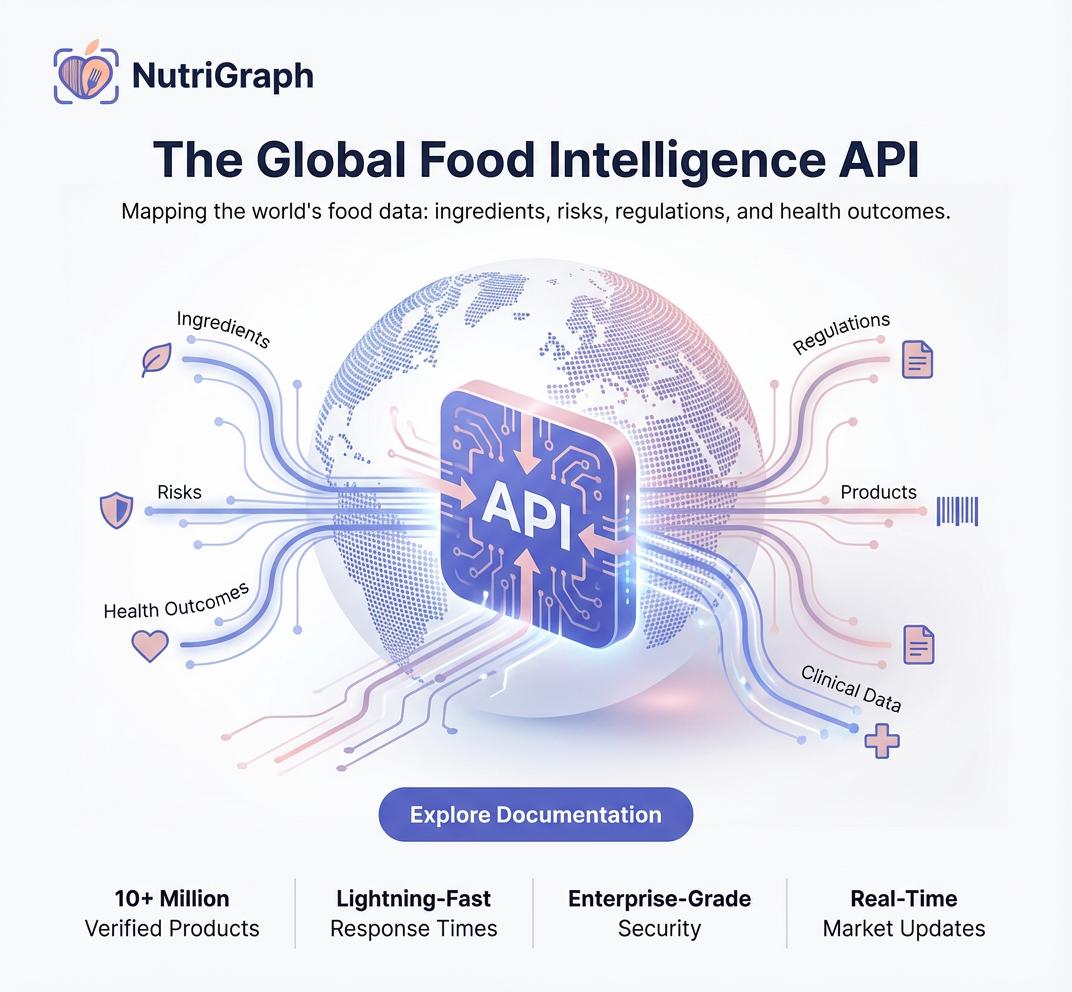
A grocery product data API provides programmatic access to a structured database of food items, including nutritional information, allergens, UPCs, and pricing. NutriGraph’s RESTful API offers real-time, UPC-verified data on over 5 million products, ensuring clinical-grade accuracy for health-tech applications and enterprise-level grocery logistics.
The High Cost of “Good Enough”: Why Generic Grocery Data APIs Fail at Scale
In the world of software development, technical debt is a familiar concept. But what about data debt? For CTOs, Lead Developers, and Founders in the health-tech and grocery e-commerce sectors, choosing a subpar grocery product data API is an exercise in accruing massive, often invisible, data debt. This debt manifests not as messy code, but as customer churn, legal liability, and a fundamentally broken user experience.
Your application—whether it’s a clinical nutrition planner, an allergen-tracking app for parents, or a multi-retailer inventory management system—is only as reliable as the data that powers it. A generic, crowd-sourced, or NLP-driven data source introduces unacceptable levels of uncertainty. These platforms often conflate similar products, provide outdated nutritional information, and, most critically, fail to accurately identify allergens. This isn’t just a bug; it’s a breach of user trust that can have severe consequences.
When a user with a severe peanut allergy scans a product, they aren’t just ‘checking a fact’; they are entrusting their well-being to your application’s data integrity. When an enterprise client relies on your inventory data for supply chain automation, inaccuracies lead to stockouts, lost revenue, and logistical chaos. The pursuit of a ‘cheap’ or ‘easy’ data solution inevitably leads to a costly and complex future of patching data inconsistencies, handling customer complaints, and mitigating brand damage.
The NLP Fallacy: A Critical Liability for Allergen Detection
The most significant point of failure in consumer-grade food APIs is their reliance on Natural Language Processing (NLP) to parse ingredient lists. On the surface, this seems like a clever, automated solution. In practice, it’s a liability engine. NLP algorithms are notoriously poor at understanding the context and nuance of food manufacturing terminology.
Consider these real-world failure points:
- Ambiguous Warnings: An NLP model might parse “Manufactured in a facility that also processes tree nuts” and incorrectly flag the product itself as containing nuts. This creates false positives, frustrating users and eroding trust.
- Context-Blind Errors: Conversely, and far more dangerously, an NLP model can miss critical allergen information. It might fail to recognize “hydrolyzed wheat protein” as a source of gluten or misinterpret complex chemical names for dairy derivatives. It cannot reliably distinguish between an ingredient and a brand name (e.g., a product named “Peanut Butter Puffs” that contains no actual peanuts).
- Lack of Verification: NLP-scraped data is unverified. It’s a machine’s best guess, not a deterministic fact. There is no source of truth to fall back on.
This is where NutriGraph establishes a clinical-grade standard. We reject the uncertainty of NLP for critical data points. Our allergen data is mapped directly and deterministically from manufacturer-provided information and cross-referenced against a specific Universal Product Code (UPC). When you query a UPC, you receive a verified, immutable list of ingredients and over 200 granular allergen flags. There is no guesswork. For any application where health and safety are paramount, this is the only acceptable methodology. Relying on NLP for allergen detection is not a technical shortcut; it’s a conscious acceptance of unacceptable risk.
Latency Kills Conversion: The Sub-50ms Imperative
In a mobile-first world, performance is a feature. A user scanning barcodes in a grocery aisle will not tolerate a multi-second delay for your app to return product information. Every 100ms of latency directly correlates with a drop in conversion and engagement. If your current grocery data API responds in 300ms, 500ms, or even over a second, you are actively harming your user experience.
This latency isn’t just a front-end issue. For enterprise systems managing thousands of SKUs, slow API calls create bottlenecks in data synchronization, reporting, and inventory management. Your entire architecture is throttled by its slowest dependency.
NutriGraph is architected with a singular focus on performance. Our global average latency is under 50ms. This isn’t an aspirational target; it’s our baseline. We achieve this through a combination of globally distributed CDN edge caching, O(1) B-Tree indexing on our primary UPC database, and highly optimized query execution. We understand that for our clients, speed is synonymous with reliability and revenue.
NutriGraph vs. The Market: A Quantitative Comparison
Choosing an API provider requires a clear-eyed assessment of technical capabilities. Vague marketing claims are insufficient. Below is a direct, quantitative comparison of NutriGraph against other common providers in the space. The data speaks for itself.
| Feature | NutriGraph API | Nutritionix / Spoonacular / Edamam (Typical) | Impact on Your Application |
|---|---|---|---|
| Latency (p95) | < 50ms (Globally) | 300ms – 1500ms+ | Instantaneous user experience vs. noticeable lag, higher user abandonment. |
| Database Size | 5M+ Verified UPCs | Unknown / Varies / Includes Duplicates | Comprehensive coverage vs. frequent “UPC not found” errors, frustrating users. |
| Allergen Detection | UPC-Mapped, Deterministic | NLP-Based, Probabilistic | Clinical-grade safety and reliability vs. high risk of false positives/negatives, legal liability. |
| Allergen Granularity | 200+ Specific Allergen Flags | 8-12 Generic Labels (e.g., “Nuts”) | Power to build apps for complex conditions (e.g., nickel, corn, nightshade allergies). |
| Data Source | Direct from Manufacturers & Retailers | Crowd-Sourced / OCR / NLP Scraped | Verifiable source of truth vs. unreliable, often inaccurate, and inconsistent data. |
| Update Frequency | Real-Time (via Webhooks) | Daily / Weekly Batches | Accurate, up-to-the-minute pricing and inventory vs. stale data leading to stockouts. |
Architected for Performance: A Look Under the Hood of NutriGraph’s API
Our claims of performance and accuracy are not abstract. They are the direct result of deliberate architectural decisions designed to serve high-throughput, mission-critical applications.
RESTful Endpoints & Predictable URLs
Our API adheres to REST principles, ensuring a predictable and logical developer experience. Endpoints are resource-oriented and straightforward. The primary endpoint for product lookup is a model of simplicity:
GET /v2/product/upc/{upc_code}
This clean structure minimizes the learning curve and allows for rapid integration. All responses are delivered in a well-structured JSON format.
Sample Request: Fetching Product Data by UPC
Testing an endpoint is simple. Using cURL, you can retrieve the full data payload for a given UPC. This allows you to immediately assess the depth and quality of our data.
curl -X GET "https://api.nutrigraphapi.com/v2/product/upc/041196912333" \
     -H "x-api-key: YOUR_DEVELOPER_KEY"
This single call returns a comprehensive dataset, including everything from macronutrients to ingredient-derived allergen flags.
Deconstructing the JSON Payload: Granularity You Can Trust
The value of an API is in the structure and reliability of its response. A sample payload from NutriGraph reveals the level of detail we provide. Note the structured allergen_flags and the data_source_verified boolean, which provides an auditable trail for data integrity.
{
  "status": "success",
  "upc": "041196912333",
  "product_name": "Organic Whole Milk Plain Yogurt",
  "brand": "Stonyfield Organic",
  "data_source_verified": true,
  "last_updated": "2023-10-27T14:08:00Z",
  "ingredients": [
    {
      "name": "Cultured Pasteurized Organic Whole Milk",
      "rank": 1
    },
    {
      "name": "Pectin",
      "rank": 2
    },
    {
      "name": "Vitamin D3",
      "rank": 3
    }
  ],
  "nutrition_facts_panel": {
    "serving_size": "1 cup (227g)",
    "calories": 150,
    "total_fat_g": 8,
    "saturated_fat_g": 5,
    "cholesterol_mg": 30,
    "sodium_mg": 115,
    "total_carbohydrate_g": 11,
    "dietary_fiber_g": 0,
    "sugars_g": 11,
    "protein_g": 8
  },
  "allergen_flags": {
    "contains_milk": true,
    "contains_peanuts": false,
    "contains_tree_nuts": false,
    "contains_soy": false,
    "contains_wheat": false,
    "contains_eggs": false,
    "contains_fish": false,
    "contains_shellfish": false
    // ... 200+ additional granular flags
  },
  "images": {
    "high_res": "https://images.nutrigraph.com/041196912333_hr.jpg"
  }
}
O(1) B-Tree Indexing and Global CDN Caching
Our sub-50ms latency is not accidental. Our primary database tables, which map UPCs to product IDs, are indexed using B-Trees. This data structure provides O(1) average time complexity for lookups, meaning retrieval time is constant regardless of whether our database has 5 million or 500 million items. For frequently accessed products, the entire JSON payload is cached at our global CDN edge locations, serving data directly from a node physically close to your user, often resulting in sub-10ms response times.
Webhooks for Real-Time Inventory & Price Updates
For enterprise grocery and logistics clients, stale data is unusable. NutriGraph offers a robust webhook integration system. Instead of constantly polling our API for changes, you can subscribe to real-time updates for specific products or categories. When a retailer updates the price or stock level of a product you’re tracking, our system sends a POST request with the updated data directly to your specified endpoint. This event-driven architecture is vastly more efficient and enables true real-time applications.
Use Cases: From Clinical Nutrition to Enterprise E-commerce
The precision and performance of the NutriGraph API make it the foundational data layer for a wide range of demanding applications.
Powering Clinical-Grade Health & Wellness Apps
Developers of apps for diabetes management, chronic kidney disease (CKD), food allergies, and complex dietary protocols (like FODMAP or Keto) require a level of data granularity that generic APIs cannot provide. Our detailed micronutrient data (potassium, phosphorus, etc.), verified ingredient lists, and extensive allergen flagging system allow you to build tools that healthcare professionals can trust and recommend to their patients.
Optimizing Multi-Retailer Grocery Logistics
Enterprise grocery chains and delivery services use NutriGraph to power their core operations. Our real-time pricing and inventory data, accessible via API or webhooks, allows for:
- Accurate Price Comparison Engines: Provide users with the best available prices across multiple banners.
- Intelligent Product Substitution: When an item is out of stock, programmatically suggest suitable alternatives based on nutritional and attribute matching.
- Supply Chain Automation: Trigger re-ordering and replenishment workflows based on real-time stock level data.
Fueling CPG Brand Analytics
Consumer Packaged Goods (CPG) brands leverage our API to monitor the digital shelf. They can track their product’s pricing, availability, and consumer-facing data across thousands of online retailers, as well as benchmark their nutritional profiles against competitors in real-time.
Your Competitive Edge is Our Data: Make the Switch
Your application is a promise to your users. A promise of accuracy, speed, and reliability. If your current grocery product data API is a source of latency, inaccuracy, and potential liability, you are breaking that promise with every call.
Stop building on a foundation of uncertain data. Stop accepting 500ms+ latencies as the cost of doing business. The technical limitations of other platforms are not your burden to bear.
We challenge you to hold your data provider to a higher standard. The same standard we hold ourselves to.
Prove it to yourself. Pull a Free 1,000-Call Developer Key at NutriGraphAPI.com and benchmark our latency and data accuracy against your current provider. The results will speak for themselves.